


It seems like one of the simplest tasks imaginable: measuring a box. Yet, if you ask any custom crate cover maker what causes the most frustration for customers, the answer is almost always the same—inaccurate measurements. It’s a small detail that has an enormous impact on the final product, turning what should be a perfect fit into a source of daily annoyance.
You bought a “36-inch crate,” so you should need a “36-inch cover,” right? Unfortunately, it’s not that simple. The world of dog crates is surprisingly inconsistent. The numbers on the box are often marketing terms, not precise dimensions. What one brand calls “Large,” another might call “Intermediate,” and their actual sizes can differ by inches.
Getting the measurements right is the first and most critical step toward getting a crate cover you love. It’s the foundation for a safe, beautiful, and functional space for your dog. This isn’t about being fussy; it’s about preventing the common and avoidable problems of sagging, pulling, and poor fit.
Why Crate Sizing Is Less Straightforward Than It Looks
The core of the problem is a lack of standardization in the pet industry. Crate manufacturers use sizing categories as a general guide for dog weight and height, not as a binding specification for the crate’s final dimensions.
Crate Brands, Models, and Materials All Measure Differently
A wire crate, a plastic crate, and a heavy-duty metal crate all have different constructions. A wire crate’s dimensions are defined by its outer frame. A plastic crate often has a rounded, tapered shape, making it wider at the middle than at the top or bottom.
Even within the same brand, different models will vary. A “Life Stages” crate from Midwest might have a slightly different height or door latch placement than their “iCrate” model, even if both are labeled as the same size. These small dog crate measurements and variations are why a “universal” cover rarely fits perfectly.
Why “Standard Sizes” Aren’t Actually Standard
The terms “36-inch,” “42-inch,” and “48-inch” usually refer to the length of the crate, but this is often rounded up or down for marketing. A crate sold as a 42-inch model might actually measure 41.5 inches long. This dog crate size confusion is a frequent source of error.
A crate size chart issues arise when these “standard” sizes are treated as exact. If a cover is made for a true 42-inch crate but yours is half an inch shorter, the cover will be baggy. These crate sizing problems are why relying on the product name or packaging is a recipe for a poor fit.
Why Accurate Measurements Matter More Than People Expect
A bad fit isn’t just a minor cosmetic issue. It has real-world consequences for the safety of your dog, the durability of the cover, and your daily experience using it.
Fit Affects Safety, Airflow, and Daily Use
A properly fitted cover stays put. A loose one can slide around, potentially blocking essential ventilation holes and creating a safety hazard. If the cover is too baggy, a bored puppy can pull the excess fabric inside the crate, turning it into a chew toy and an ingestion risk.
Functionally, an ill-fitting cover is a nuisance. If it’s too tight, the zippers will be strained and difficult to operate. If the front panel is too long, it will drag on the floor when you open it, collecting dust and getting caught under the door. A precise dog crate cover fit is about creating a product that works seamlessly, without constant adjustment.
How Small Errors Lead to Big Fit Problems
On a soft object like a pillow, a half-inch error is unnoticeable. On a rigid wire frame, it’s glaring. If your measurements are off by just one inch in width, the cover will either be too tight to close or so loose that the top sags visibly between the bars.
A crate cover too small will pull at the seams, leading to premature tearing. A crate cover too big looks sloppy and unprofessional. This is often the main reason for crate cover returns. Getting the numbers right from the start is the best way to ensure a beautiful and functional result.
What You Need Before Measuring a Dog Crate
You don’t need specialized equipment, but you do need the right tool and the right mindset. Precision is the goal.
Tools That Make Measurements Reliable
The best tool for the job is a rigid, retractable metal measuring tape—the kind you find in any hardware store. A soft tailor’s tape (the kind used for sewing clothes) can stretch or sag, leading to inaccurate readings. A wooden yardstick is too clumsy for getting into corners.
Using the right dog crate measuring tape ensures you are getting a true, straight-line measurement. You’ll also want a pen and paper to write down the dimensions immediately. Don’t try to remember them.
Why Guessing or Estimating Doesn’t Work
“It looks about three feet long” is not a measurement. Eyeballing the dimensions is the fastest way to get a cover that doesn’t fit. Crate measurement mistakes happen when we assume we can judge distance accurately.
This is especially true with DIY crate cover issues. If you are going to invest the time and money to sew your own cover, you owe it to yourself to work with accurate numbers. Crate sizing errors made at the beginning will haunt you through the entire project.
Step-by-Step: How to Measure Your Dog’s Crate Correctly
Take five minutes to do this methodically. It will save you hours of frustration later. Always measure the outside of the crate, from edge to edge.
Step 1: Measure the Exterior Width
Start with the width of the crate. This is usually the shortest dimension. Place your measuring tape on one side and extend it across to the other side. Make sure the tape is straight and level. Measure from the outermost wire on the left to the outermost wire on the right. Write this number down. This is your crate width measurement.
Step 2: Measure the Exterior Depth (Front to Back)
Next, measure the depth, which is often called the length. This is the longest dimension. Run your tape measure along the side of the crate, from the front corner to the back corner. Again, ensure the tape is straight and not sagging. Record this crate depth measurement.
Step 3: Measure the Full Height—Including the Tray
The height is the most commonly mistaken measurement. You must measure the total exterior height, from the floor to the very top wire of the crate. Do not measure from the top of the plastic tray. A cover needs to go all the way to the floor to look finished and hide the tray. So, place the end of your measuring tape on the ground and extend it straight up to the top. This is your crate height measurement.
Step 4: Check for Protrusions, Doors, and Hardware
Finally, take note of any parts that stick out. Does your crate have suitcase-style handles on top? Does the latch mechanism stick out an extra inch from the front? Measure these protrusions. This crate hardware dimensions information can be important for ensuring proper door clearance and a clean fit.
Why Exterior Measurements Matter More Than Interior Ones
When ordering a cover, you are essentially ordering a “hat” for the crate. You need to know the size of the head, not the size of the brain inside.
The Most Common Measuring Mistake People Make
The most common error is measuring the inside of the crate. People assume the cover should fit the interior space, but a cover must wrap around the exterior frame. Interior vs exterior crate measurements can differ by as much as an inch or two, which is more than enough to cause a fit problem. This is the number one crate cover sizing mistake.
How Interior Measurements Lead to Tight or Unusable Covers
If you provide interior measurements, the resulting cover will be too small. You will not be able to get it onto the crate without a struggle, if at all. The fabric will be stretched taut across the frame, putting immense strain on the seams and zippers. In nearly every case, a crate cover doesn’t fit because the measurements provided were for the interior space, not the exterior frame.
Common Measuring Mistakes That Cause Fit Problems
Beyond the interior/exterior mix-up, a few other common errors can trip people up.
Relying on Manufacturer Listings
As we’ve discussed, the crate dimensions listed on a website or on the box are often rounded marketing numbers. Never trust them. Manufacturer crate size errors are frequent. Always measure your specific, physical crate.
Measuring Only One Side or One Section
Crates are not always perfectly square. Due to manufacturing tolerances or wear and tear, one side might be slightly different from the other. It’s a good practice to measure the width and height at both the front and back of the crate to check for consistency. If there is a slight discrepancy, use the larger of the two measurements.
Forgetting About Clearance and Ease
Some people measure so precisely that they forget a cover needs a tiny bit of “ease” to slide on and off without a fight. A good cover should not be skin-tight. There should be a small amount of wiggle room—this is known as crate cover ease allowance—to account for the texture of the fabric and the process of putting it on.
How Much Extra Space a Crate Cover Needs
This is where the art of the craft comes in. A well-designed cover is not just a fabric box made to your exact measurements; it includes a carefully calculated amount of ease.
Understanding Ease vs Excess Fabric
“Ease” is a tailoring term for the small amount of extra room built into a garment to allow for movement and comfort. For a crate cover, this might mean adding a quarter to a half-inch to the pattern dimensions. This is different from having a baggy, oversized cover.
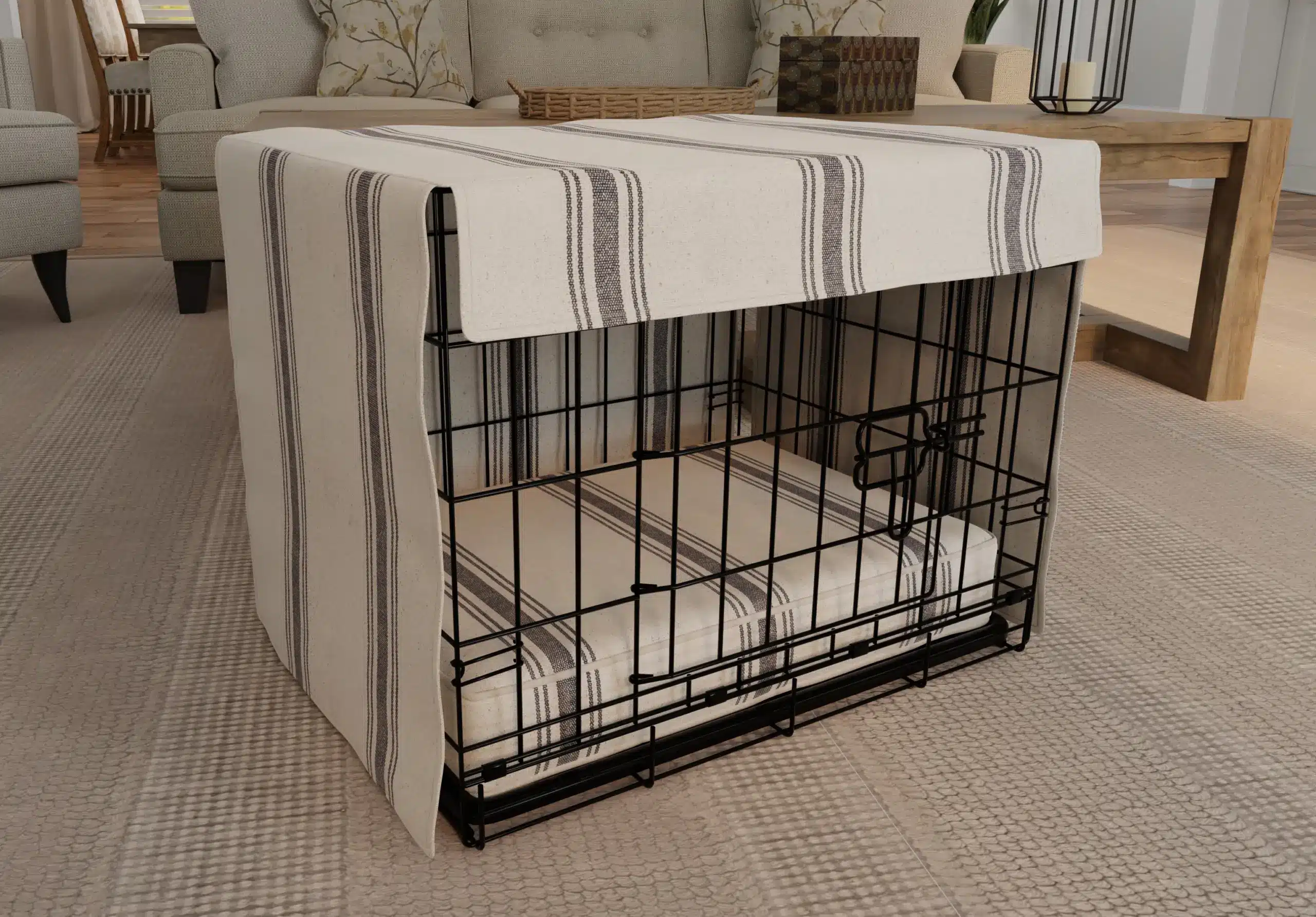
Crate cover ease ensures the cover slips on smoothly. Excess fabric, on the other hand, is the result of generic sizing and creates the sagging, sloppy look we want to avoid. A tailored crate cover fit has just enough ease to be functional without compromising its clean lines.
Why a Perfect Fit Still Needs Breathing Room
That small amount of ease also contributes to better airflow. A cover that is stretched taut against the frame can impede the passive movement of air through the fabric. A slightly looser fit (but not baggy) allows for micro-gaps that help with ventilation.
Measuring Wire Crates vs Plastic Crates
The principles are the same, but the shapes present different challenges.
How Wire Construction Changes Measurements
Wire crates are straightforward because they are essentially cubes. The key is to measure from the outermost point of the wire frame on all sides. Be mindful of latches that stick out. Wire dog crate measurements are all about capturing the largest possible “box” that the cover needs to enclose.
Why Plastic Crates Create Different Fit Challenges
Plastic travel crates are notoriously difficult to fit. They are often tapered, with rounded corners and sloped sides. The widest point might be in the middle. When measuring a plastic dog crate, you need to capture the maximum width, depth, and height at its absolute largest points. Because of their irregular shapes, a custom cover is often the only way to get a decent fit.
Double-Checking Measurements Before Ordering or Sewing
Measure twice, cut once. This age-old advice is your best defense against costly mistakes.
When and How to Re-Measure
After you’ve taken your first set of measurements, walk away for a few minutes. Then, come back and do it again from scratch, without looking at your first set of numbers. Compare the two sets. If they match, you can be confident. If they differ, measure a third time to find the correct dimension.
Why One Final Check Prevents Costly Mistakes
Taking an extra two minutes to verify crate measurements is free. Ordering a new cover because the first one didn’t fit is not. This simple step is the best form of insurance against crate cover returns prevention and ensures you get the crate sizing accuracy you need for a professional result.
Why Made-to-Order Crate Covers Depend on Accurate Measurements
In the world of custom work, the maker is relying entirely on the information you provide. The final product is a direct reflection of the input.
Custom Fit Only Works When the Inputs Are Right
A custom maker patterns your cover based on the exact numbers you give them. If those numbers are wrong, the cover will be wrong. Custom dog crate cover sizing is a partnership between you and the maker. You provide the precise data; they provide the skilled execution.
How Measurement Accuracy Impacts Final Results
The difference between a stunning, furniture-like piece and a frustrating, ill-fitting cover lies in the accuracy of the initial measurements. When the numbers are right, the custom crate cover results are seamless. The seams align with the crate edges, the doors operate smoothly, and the overall look is clean and intentional. This is where the quality of a tailored crate cover truly shows.
What Happens When Measurements Are Off
Even small errors manifest in noticeable ways.
Common Fit Issues Caused by Inaccurate Sizing
If the cover is too big, you will see crate cover sagging on the top panel and fabric puddling at the bottom. If it’s too small, you’ll see crate cover pulling at the corners, and the seams will be under visible strain. Crate cover door misalignment is another common issue, where the cover’s opening doesn’t line up correctly with the crate’s door.
Why Adjusting After the Fact Is Rarely Simple
Altering a finished crate cover is not easy. Heavy canvas is difficult to sew on a standard home machine. If a cover is too small, there is no extra fabric to let out. If it is too big, taking it in requires deconstructing and re-sewing multiple seams. These are not simple DIY crate cover fixes. It’s always better to get it right from the start.
When to Measure Again (New Crates, Growing Dogs, Replacements)
Your measurements have a shelf life. Don’t assume they are good forever.
Why Re-Using Old Measurements Can Backfire
If you buy a new crate, even if it’s the “same size” from the “same brand,” you must measure it again. Manufacturers can change their tooling and specs over time. Relying on old numbers for new crate measurements is a common mistake that leads to disappointment.
Puppies, Size Changes, and Crate Swaps
As your puppy grows, you will likely upgrade their crate. A crate sizing for puppies plan means you’ll be measuring for a new cover when they move into their adult-sized home. Don’t assume your medium crate cover will fit your large crate. Every crate size change requires a new set of measurements.
A Simple Checklist Before You Finalize Measurements
Before you click “order” or start cutting your fabric, run through this one last time.
What to Confirm Before Ordering or Cutting Fabric
- Did I use a rigid metal measuring tape?
- Did I measure the exterior width, depth, and height?
- Did I measure the height from the floor to the top?
- Did I write the dimensions down immediately?
- Did I re-measure to confirm?
This simple crate measurement checklist is your best friend.
How Accurate Measuring Saves Time and Frustration
Taking the time to measure correctly provides crate cover buying confidence. It transforms the process from a guessing game into a precise, predictable project. Crate sizing clarity eliminates the biggest variable and sets you up for a successful outcome that you’ll be happy with for years to come.
Common Questions About Measuring Dog Crates
Should I Measure the Crate or Use the Listed Size?
Always measure the physical crate yourself. Manufacturer-listed sizes are often rounded and inconsistent between brands.
How Exact Do Measurements Need to Be?
Be as exact as possible, down to the nearest quarter of an inch. A small error can result in a noticeably poor fit. Provide the precise measurements to your maker; they will factor in the necessary “ease” for a perfect fit.
What If My Crate Is Between Sizes?
This is why custom sizing is so valuable! If you are measuring for a store-bought cover and your crate falls between two sizes, it’s generally safer to size up, but be prepared for a baggy fit. If ordering custom, you just provide the exact, “in-between” measurements.
Why Does Custom Sizing Rely So Heavily on Accuracy?
Custom work is precise by nature. The goal is to create a cover that fits like a glove, not a loose mitten. This level of tailoring is only possible when the maker has exact, reliable dimensions to work from. Your accuracy is the key to their craftsmanship.
Give Your Pet the Comfort They Deserve
Crafted by hand, built to last, and designed to match your home. Create the perfect bed for your best friend.
Customize Their Bed
0 Comment