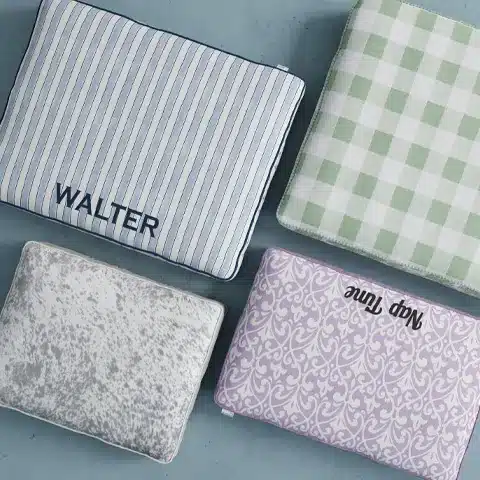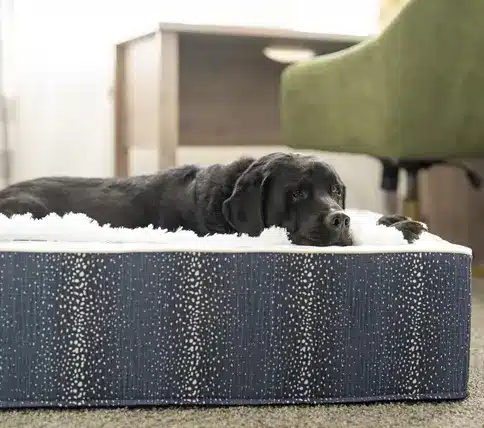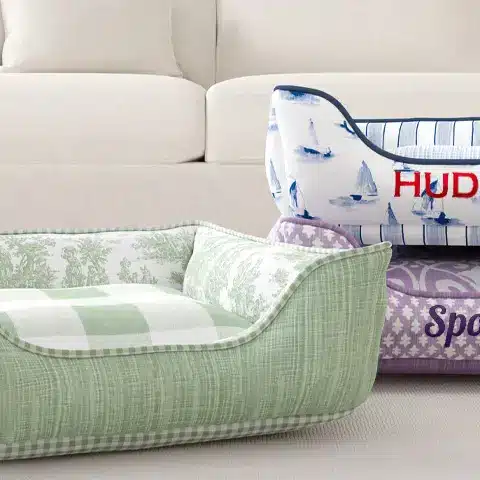

The short answer: a bed for a dog with arthritis should support the whole body evenly, hold that support night after night, and be easy to get into and out of. In practice that means a thick foam insert (4″ memory foam for even, pressure-relieving support, or high-density foam for a firmer surface that keeps its shape), a low entry, enough room to lie flat, a bottom that does not slide and a cover you can wash. Your vet knows your dog’s joints; this list covers what to look for in the bed.
Arthritis changes how a dog sleeps. A dog who used to flop anywhere starts choosing the softest spot, takes longer to lie down, and is stiff when they get up. A good bed will not treat the condition, and we are not going to pretend otherwise, but it can make lying down, sleeping and standing up easier. Every J’adore bed is made to order, so each of the nine things below is a choice you make when you design the bed rather than a feature you hope the store has in stock. If your dog has a diagnosis, ask your vet which kind of support they recommend before you order.
1. Even Support Across the Whole Body
The first job of the bed is to keep hips, elbows and shoulders from pressing into the floor. A thin or flattened bed lets the heaviest points sink through, so the dog is effectively lying on the hard surface underneath. Our 4″ memory foam is made for this. It is a 4 lb density foam that spreads your dog’s weight evenly instead of letting it concentrate at the joints, which is why it is a popular choice for senior dogs, and it has a typical life of 10 or more years.
Memory foam is offered on the Rectangle, Square, Round and Cave cushion beds, and in the seat of the Cuddle, Cozy Cuddle, Edgy and Throne bolster beds. Our fill guide compares every fill side by side.
2. Firmness That Does Not Give Up
Some dogs with sore joints do better on a firmer surface, because a bed that is too soft makes standing up harder. For them, high-density foam is the choice. It is a dense polyurethane foam with a layer of batting on the top and bottom, CertiPUR-US certified, with a typical life of 12 or more years. It is our firmest fill and the one that holds its shape longest under a heavy dog.
High-density foam comes in 4″ and 5″ thicknesses on the Rectangle and Square. The 5″ is for giant breeds and dogs who need maximum support. It is also always what the Throne’s four bolsters are made of, so a Throne gives a firm edge to push against when getting up. Not sure whether your dog wants even or firm? That is a good question for your vet, and the answer often depends on the dog’s weight.
3. A Low Entry
Climbing over a tall bolster is the hardest part of bedtime for a stiff dog. Three of our beds solve this in different ways:
- The Pillow Dog Bed is our lowest-profile cushion with no raised edge at all. Your dog steps on, not in.
- The Cuddle Bolster Dog Bed has bolsters on the back and sides and a dipped front, so there is something to lean on and an easy step over the front.
- The Edgy Bolster Dog Bed has three foam bolsters and an open front, which gives a firm headrest without a wall to climb.
A flat cushion like the Rectangle or Round is also an easy entry, with the 4″ or 5″ thickness of a foam insert being the only step.
4. Room to Lie Flat
A dog with stiff joints often stops curling up and starts sleeping on their side with legs extended, because it is the most comfortable position. The bed has to be long enough for that. Measure your dog lying stretched out from nose to the base of the tail, then add 8 to 12 inches for a cushion bed or 5 to 8 inches for a bolster bed, and compare it with the bed’s size chart. When a dog is between sizes, go up. Our size guide has the charts for every bed, and a custom size is there for the dog who does not fit a standard one.
5. A Bottom That Stays Put
A bed that slides on a hardwood or tile floor makes a careful dog more careful still, and a scramble to stand up is exactly what sore hips do not need. On our cushion beds, Grip Slip-Not is offered as the bottom fabric. It is a non-slip fabric used on the underside only, and it helps keep the bed where you put it. Choose it under Bottom Fabric when you design the bed.
6. Warmth
Many dogs with joint stiffness seek out warm spots. A plush fabric on the sleeping surface helps hold body heat: our velvets, Bonded Sherpa (in white, ivory, black and dark gray) and Furry Fleece are the soft, warm choices. The Throne comes with an attached furry fleece blanket to tuck under, and the Cave has an attached blanket over a cushion. You can also keep a dog warm with placement, which is item nine. Our fabric guide explains each fabric family.
7. A Washable Cover and a Protected Insert
An older dog with arthritis may also have the occasional accident, and a foam insert can never go in the washing machine. So two things matter: a cover that unzips and washes, which every J’adore bed has, and an optional waterproof insert cover that sits over the insert, under the outer cover, and keeps liquid out of the foam. It wipes clean or washes cold and line dries. On bolster beds you can protect the seat alone or the seat and the bolsters. With both in place, a wet night is a load of laundry rather than a ruined bed. Our care guide covers the washing routine.
8. The Right Thickness
Thickness is what keeps a heavy dog off the floor. Our memory foam is 4″ thick, and high-density foam is 4″ or 5″. On a cushion bed the fill also sets the height of the band, the side wall of the cover: 3″ for 4″ memory foam and 4″ high-density foam, 4″ for 5″ high-density foam and for fiberfill. For a large or giant breed with sore joints, the 5″ high-density foam on the Rectangle or Square is the most support we make.
9. The Right Spot in the House
The last item is not part of the bed, but it decides how much the bed helps. Put it away from drafts and off cold tile, on a floor your dog can walk across without slipping, and close to where the family spends the evening so your dog is not climbing stairs to be with you. If your dog’s day moves between floors, a second bed saves them the trip. Dogs who are stiff in the morning do better with a bed near where they wake up and a short, flat walk to the door.
Putting It Together
| If your dog… | Consider | With this fill |
|---|---|---|
| Lies flat on their side | Rectangle or Pillow, sized a step up | 4″ memory foam or high-density foam (Rectangle) |
| Leans but struggles to climb in | Cuddle (dipped front) or Edgy (open front) | Memory Foam Seat |
| Needs a firm edge to push up from | Throne | High-density foam bolsters, memory foam seat |
| Curls up small | Round or Cave | 4″ memory foam |
| Is a giant breed | Rectangle or Square, custom size if needed | 5″ high-density foam |
Every one of these is made to order in our Kansas City workroom in the fabrics you choose, with free name embroidery, free ground shipping within the continental US and a 1-year limited warranty. For a longer look at supporting an older dog, read our guide to custom orthopedic dog beds for senior dogs, and for the soft-versus-supportive question, orthopedic vs. plush dog beds.