



As pet owners, we instinctively want to create spaces for our dogs that feel safe, comfortable, and loving. When it comes to a dog crate, that instinct often translates into a desire to make it “cozy.” We fill it with soft blankets and fluffy beds, trying to transform a wire or plastic box into a warm and inviting den. This impulse comes from a place of care, as we try to give our pets the same sense of comfort we seek for ourselves.
However, creating a truly comfortable and effective crate space goes beyond just adding softness. It involves a more thoughtful approach, one that considers a dog’s natural instincts and sensory experiences. A space that feels cozy to a human—filled with plush pillows and heavy blankets—might not feel the same way to a dog. True comfort for a canine companion is a careful balance of security, quiet, and environmental control. It’s about building a space that helps them feel settled and secure, which in turn allows them to rest deeply.
This process involves looking at the crate not as an isolated object, but as part of the larger home ecosystem. It’s about designing a space that supports your dog’s well-being while still feeling like an integrated, beautiful part of your home.
Why “Cozy” Doesn’t Mean the Same Thing for Every Dog
The word “cozy” brings to mind images of warmth, softness, and enclosure. For humans, it’s a feeling we actively seek out. But for dogs, the concept of a cozy dog crate is more nuanced. While some dogs love to burrow into a pile of blankets, others prefer a cooler, flatter surface. Some are sensitive to visual stimuli and need near-total darkness to settle, while others are content with a light covering.
Our human assumptions about comfort can sometimes miss the mark. A dog who constantly kicks their blankets into a corner isn’t being difficult; they are communicating a preference. A dog who pants in a heavily padded bed might be telling you they are too warm. Understanding what makes your individual dog feel secure is the first step toward creating a space that is genuinely comfortable for them, not just one that looks comfortable to us.
Understanding Comfort Through Behavior, Not Assumptions
The best way to create a comfortable dog crate is to become an observer of your own dog’s behavior. Their actions are a direct form of communication, offering valuable clues about what they need to feel safe and relaxed.
Burrower or Sprawler? Watch how your dog sleeps outside the crate. Do they curl up tightly and seek out enclosed spaces, like under a table or in a closet? This might be a dog that would appreciate a fully covered crate and a softer bed to nest in. Or do they sprawl out on cool tile floors, seeking to regulate their body temperature? This dog might prefer a crate with more open panels and a firmer, less insulated bed.
Sensitive to Sound and Sight? Notice what startles your dog. Do they bark when someone walks past the window or jump at every little noise? This is often a sign of a dog that could benefit from the visual and auditory muffling a good crate cover provides. By reducing sensory input, you help lower their state of arousal, making it easier for them to settle. These dog crate comfort ideas are rooted in observation, not just decoration.
By paying attention to these small but significant behaviors, you can move beyond generic ideas of coziness and tailor the crate environment to what your dog is actually telling you they need.
Using Light, Sound, and Visual Boundaries to Support Calm
A dog’s sense of calm is deeply connected to their environment. For many dogs, especially those prone to anxiety or overstimulation, the world can feel like a very loud and busy place. A crate’s primary function, beyond containment, is to provide a sanctuary from that chaos. Creating a quiet dog crate setup is about intentionally managing the sensory information that reaches your dog.
This is achieved by establishing clear boundaries—not just physical, but visual and auditory as well. By controlling the light, muffling ambient noise, and blocking distracting movement, you create a predictable and low-stimulus environment. In this quiet space, a dog’s nervous system can downshift from a state of high alert to one of rest and relaxation. This is why a simple wire crate in the middle of a busy living room often fails to be a restful place; it contains the dog physically but does little to protect them from the environmental stressors that prevent them from settling.
How the Environment Around the Crate Affects Settling
The effectiveness of a crate as a calming tool depends heavily on how you manage the space immediately surrounding it.
Light Control: Uncontrolled light can be disruptive. The flash of headlights through a window or the flickering of a television screen can keep a dog on high alert. A good crate cover is essential for managing light. For a dog crate cover for anxiety, the ability to create a dark, den-like space is crucial. It signals to the dog’s brain that it’s time for rest, much like blackout curtains do for a human bedroom. It’s not about total isolation, but about providing a consistent and predictable level of light that isn’t subject to the random changes of the outside world.
Sound Dampening: While a fabric cover won’t soundproof a crate, it does help to muffle ambient noise. The hum of the refrigerator, the sound of footsteps on a hardwood floor, or conversations in the next room can all be slightly dampened by a layer of heavy fabric. This small reduction in auditory input can make a significant difference for a sound-sensitive dog.
Visual Boundaries: For many dogs, sight is their most stimulating sense. A person walking by, another pet playing, or even just the flutter of leaves outside a window can be enough to trigger excitement or anxiety. A crate cover for calming dogs works by creating a visual boundary. It effectively puts blinders on the dog, removing the constant stream of movement that can make it difficult for them to switch off. This visual quiet is often the most important factor in helping a dog learn to settle in their crate.
Fabric and Fit Choices That Help a Crate Feel Secure
When we aim to make a crate feel secure, our first thought is often softness. We pile in blankets and cushions, believing that more padding equals more comfort. While a soft bed is important, the true sense of security comes from something more structural: the feeling of a well-defined, predictable space. This is where the fabric and fit of a crate cover play a surprisingly critical role.
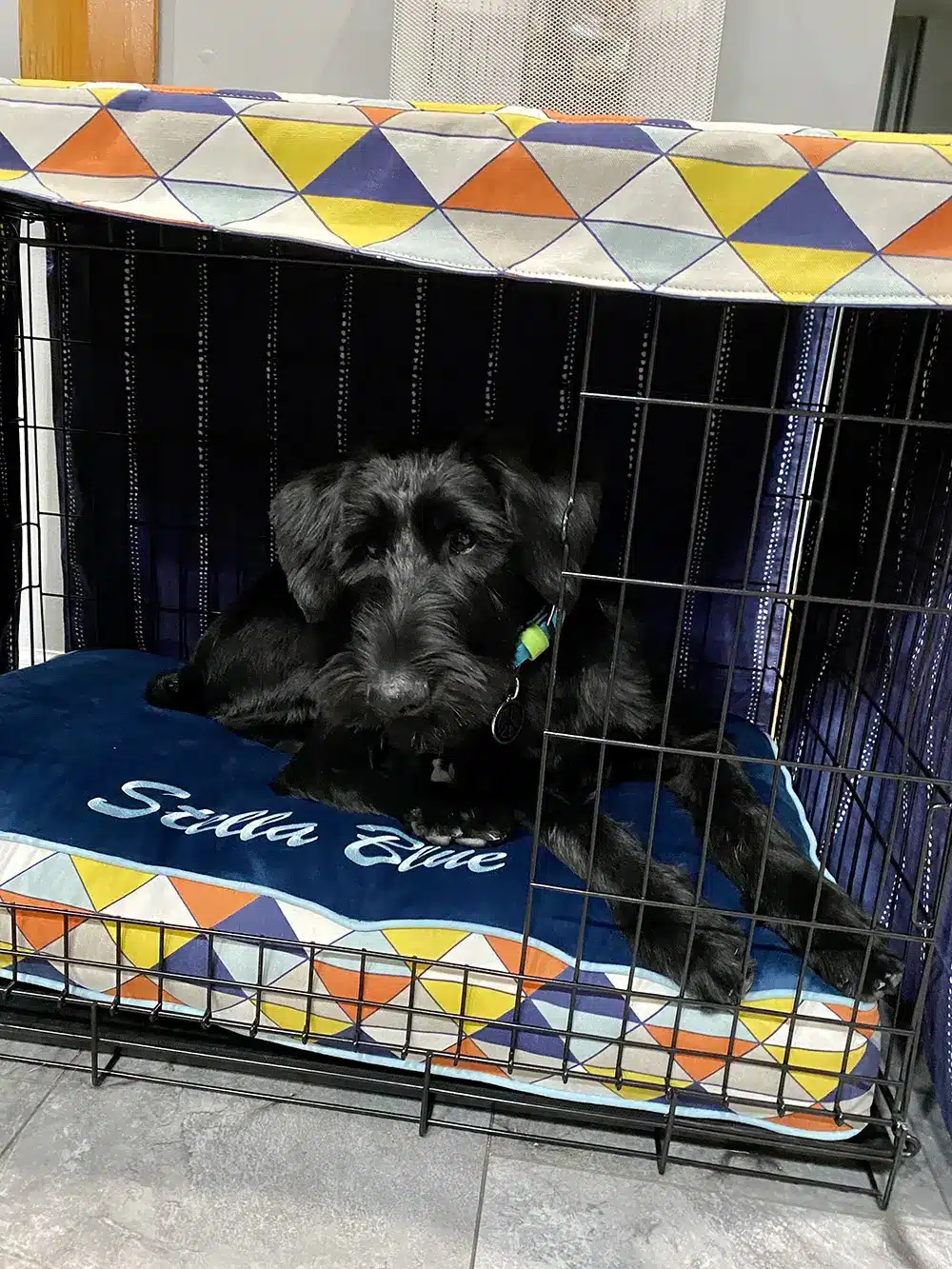
A cover that fits properly, with clean lines and taut fabric, transforms the crate from a cage into a small room. This structure provides a psychological boundary that a loose, sagging blanket cannot. Furthermore, the type of fabric matters immensely. It must provide a sense of enclosure while ensuring the space remains safe and breathable. Security is as much about a healthy environment as it is about a soft one.
Why Structure and Breathability Matter as Much as Softness
The most comfortable dog crate cover is one that balances the feeling of a den with the physical need for a safe, healthy environment.
The Security of Structure: A custom dog crate cover fit is foundational to creating a sense of security. A cover that is tailored to the crate’s exact dimensions has crisp corners and straight lines. This structure is calming because it’s predictable. It won’t slip, slide, or get pulled into the crate by a curious dog. This stability creates a reliable environment that a dog can trust. In contrast, a constantly shifting blanket creates an unpredictable space, which can be a source of anxiety.
Breathability is Non-Negotiable: A feeling of security is impossible if the dog feels stuffy or overheated. A breathable dog crate cover is essential for safety and comfort. Natural fibers like cotton canvas are ideal because they allow air to pass through the weave, preventing the buildup of hot, stale air. A breathable fabric ensures that even when the crate is fully covered to block light, the environment inside remains fresh and healthy. This is a critical aspect that should never be compromised for aesthetics.
By prioritizing a structured fit and breathable materials, you create a space that feels both mentally secure and physically comfortable—a true sanctuary for your pet.
How Crate Covers Contribute Without Overdoing It
A common concern when covering a dog crate is the fear of “overdoing it.” Will the dog feel trapped? Will it get too hot? Is it cruel to block their view entirely? These are valid questions that stem from a place of care. The goal of a crate cover is to create a peaceful den, not a restrictive prison. The key to achieving this balance lies in thoughtful design and functional flexibility.
A well-designed crate cover provides the benefits of enclosure—light reduction, visual boundaries, sound muffling—without creating a sealed-off, stuffy box. It should be a tool that enhances the crate environment, not one that detracts from it. This is achieved through the use of breathable fabrics, adjustable panels, and a fit that respects the need for constant, reliable airflow.
Creating Comfort Without Making the Space Feel Closed Off
A safe dog crate cover is designed to be a semi-permeable barrier. It controls the environment without cutting it off completely.
Maintaining Airflow: The most important feature is dog crate cover airflow. Even when all panels are down for maximum darkness, a cover made from a breathable material like heavy cotton canvas allows for passive air exchange. Furthermore, a properly fitted cover hangs straight, leaving a natural gap between the fabric and the crate’s wire bars. This space is crucial, as it allows air to circulate around the entire crate, preventing the fabric from being “sucked in” and blocking ventilation.
Functional Flexibility: A functional dog crate cover should be adaptable. Roll-up panels that correspond to the crate’s doors and windows are a perfect example of this. You can choose to have all panels down for nighttime sleep, roll one up to allow a view during the day, or roll up multiple panels to create a breezy, open-air feel. This flexibility allows you to customize the level of enclosure to your dog’s needs and the time of day, ensuring they never feel uncomfortably confined.
A crate cover should be a tool that offers options. It empowers you to create the exact right environment for your dog at any given moment, providing security without sacrificing safety or comfort.
Balancing Comfort With a Home That Still Feels Open and Lived-In
Creating a cozy den for your dog doesn’t mean you have to sacrifice the style and comfort of your own living space. For too long, pet ownership felt like a choice between a beautiful home and a happy pet. The reality of modern, pet-friendly home design is that you can, and should, have both. The crate does not have to be an eyesore you hide in a corner. It can be an intentional, integrated part of your home.
This balance is achieved when you start to think of your dog’s crate space as a piece of furniture. By applying the same design principles you use for the rest of your home—considering color, texture, and placement—you can transform the crate from a visual disruption into a harmonious element. It’s about designing a space that works beautifully for everyone who shares it, two-legged and four-legged alike.
Designing a Crate Space That Works for Dogs and People
A successful crate space honors the needs of both the dog and the human.
For the Dog: The space needs to feel safe and den-like. This means placing the crate in a quieter corner of a main room, away from high-traffic pathways. A dog crate in a living room, for example, is often best placed against a wall, which provides a solid side and reduces their need to monitor all directions. A well-designed dog crate cover home décor piece provides the visual boundaries they need to relax amidst family life.
For the Person: The space needs to look and feel like part of the home. This is where a custom cover shines. You can choose a fabric and color that complements your sofa, rug, and curtains, making the crate feel like a deliberate part of the design scheme. A perfectly fitted cover creates clean, architectural lines that are pleasing to the eye. Some owners even place a sturdy tray on top of the crate, turning it into a functional end table for a lamp or a plant, further integrating it into the room.
Ultimately, great pet-friendly home design is about thoughtful integration, not compromise. It’s about creating a single, cohesive environment where the comfort of your pet and the beauty of your home are one and the same.
Common Questions About Creating a Cozy Dog Crate Space
What Makes a Dog Crate Feel Calm Instead of Confining?
A crate feels calm when it functions as a secure den, not just a cage. This is achieved by reducing sensory input. A properly fitted cover that blocks visual distractions and muffles sound helps lower a dog’s arousal state. The space should be large enough for the dog to stand up and turn around comfortably, but not so large that it doesn’t feel enclosed. Predictability is also key; a crate that is consistently used as a safe, quiet place for rest will be perceived as calming over time.
How Much Should a Dog Crate Be Covered?
This depends on the individual dog and the situation. For a dog that is easily overstimulated or anxious, fully covering the crate (while ensuring a breathable fabric is used) can be most effective for promoting sleep. For a more confident dog or for daytime use, you might leave one or two panels rolled up to allow for more light and a view. The ideal solution is a cover with adjustable panels, so you can tailor the level of coverage to your dog’s needs.
Can a Crate Cover Make a Dog Feel More Secure?
Yes, for most dogs, a crate cover can significantly enhance their sense of security. Dogs are den animals by instinct, and an enclosed space feels safer than an open one. A cover transforms a wire cage into a den-like environment, providing a visual barrier from the movements and activities of the household. This allows them to relax fully, knowing they won’t be startled or disturbed. For many dogs, a covered crate becomes their personal, private space where they can truly rest.
Give Your Pet the Comfort They Deserve
Crafted by hand, built to last, and designed to match your home. Create the perfect bed for your best friend.
Customize Their Bed
0 Comment