


We make thousands of decisions for our pets over their lifetimes. Some are big, like choosing a vet or deciding on a diet. Others feel small, like picking out a collar or a water bowl. Choosing a crate cover usually falls into that second category. It feels like a simple accessory, something you grab off the shelf while you’re buying food or toys.
But if you use a crate daily—and especially if that crate lives in your living room or bedroom—this “small” decision actually carries a lot of weight. The crate cover is one of the few pet products that acts as both a piece of furniture and a tool for your dog’s well-being. It takes up visual space in your home, and it directly impacts your dog’s environment for hours every day.
When you start looking at options, the divide is clear: there are the covers you can pick up at a big-box store for immediate use, and there are custom covers made to order. At first glance, the difference might seem to be just price and shipping time. But when you look closer—at the fit, the fabric, the safety, and the longevity—the gap between the two widens significantly.
This isn’t about convincing you that one is universally “right” and the other is “wrong.” It’s about helping you understand the trade-offs so you can make the choice that fits your life, your budget, and your dog’s needs for the long haul.
Why This Comparison Matters More Than It Seems
It’s tempting to think of a crate cover as just a piece of fabric. Its job is to cover the crate, right? While that’s technically true, the way it does that job changes your daily experience with it.
Crate Covers Look Simple, but the Differences Add Up Over Time
On day one, a store-bought cover and a custom cover might accomplish roughly the same thing: they darken the crate. But fast forward six months.
The store-bought cover might have started to sag in the middle, creating a messy silhouette. The ties might have frayed or knotted so tight you can’t undo them. The fabric might have absorbed odors that won’t wash out, or maybe it shrank in the dryer and no longer reaches the bottom of the crate.
In contrast, a well-made custom cover is still holding its shape. The lines are crisp. The fabric feels substantial. The difference isn’t just in how it looks; it’s in the daily friction. It’s the difference between constantly adjusting a sliding sheet and having a piece of gear that stays put and does its job without fuss. When you multiply those small interactions by 365 days a year, the “simple” difference becomes a major quality-of-life factor.
Why Many People Revisit This Decision More Than Once
We see a common pattern with pet parents. They start with a generic cover because it’s easy and accessible. Then, a year later, they replace it because it ripped or looked tattered. A year after that, they replace it again.
Eventually, after spending the equivalent of a custom cover on three or four disposable ones, they look for a better solution. Understanding the custom vs store bought crate cover landscape upfront can save you from this cycle of dissatisfaction and repurchase. It allows you to decide if you want a temporary fix now or a permanent solution for the future.
What Store-Bought Crate Covers Do Well
Let’s be fair: store-bought covers have their place. They dominate the market for a reason, and in certain scenarios, they are exactly what a pet owner needs.
Immediate Availability and Lower Upfront Cost
The biggest advantage of a store-bought dog crate cover is accessibility. If you bring a puppy home unexpectedly or realize you need a cover for a trip tomorrow, you can walk into a store and walk out with a solution. There is zero lead time.
They are also significantly cheaper upfront. Mass production allows for economies of scale that handmade goods simply cannot match. If your budget is tight or if you aren’t sure if your dog will even use a crate long-term, a cheap dog crate cover offers a low-risk entry point. An affordable crate cover gets the job done when speed and budget are the primary drivers.
Standard Sizing for Common Crate Models
Most mass-produced covers are designed to fit standard wire crate dimensions (typically 24, 30, 36, 42, and 48 inches). If you own a popular brand of crate like a Midwest or Frisco, a standard dog crate cover will likely fit reasonably well.
It won’t be perfect—there’s usually generous wiggle room built in to accommodate slight manufacturing variations—but it will cover the cage. For many people, specifically those with standard setups and standard needs, this “close enough” fit is acceptable, especially for a wire crate cover or metal crate cover that lives in a garage or a laundry room.
Where Store-Bought Covers Start to Fall Short
The limitations of mass production become apparent once you move the crate into your living space and start using it daily. The compromises made to keep costs low and stock high often result in functional annoyances.
Fit Issues That Show Up in Real Homes
“Universal” is a tricky word in manufacturing. To make a cover universal, it has to be big enough to fit the largest version of a specific size category. The result is almost always a dog crate cover too big for the actual crate.
You’ll see this as excess fabric pooling on the floor, which collects dust and hair. You’ll see it in the corners, which droop rather than sitting square. You see it in the front panel, which might drag on the ground when unzipped. Crate cover fit issues like these make the crate look sloppy, no matter how tidy the rest of your room is. It creates a “baggy clothes” effect that undermines the aesthetic of your home.
Fabric Quality and Wear Over Time
To hit a lower price point, store-bought covers usually utilize thin synthetic materials, often polyester or a lightweight nylon blend. While these materials are cheap to produce, they lack durability.
Crate cover durability issues surface quickly with active dogs. A scratching paw can easily tear thin fabric. Sunlight from a nearby window can cause significant fading within months, turning a black cover into a rusty grey. Cheap crate cover fabric often lacks the weight to hang straight, contributing to that messy, wrinkled look that never quite goes away.
Limited Control Over Airflow, Coverage, and Design
Perhaps the biggest functional drawback is the lack of options. A generic cover typically has one configuration: front door open, everything else closed.
If your dog runs hot, you can’t easily roll up the sides for cross-ventilation. If you have a double-door crate, you might find the cover blocks the side exit entirely. Store bought crate cover problems often center on this rigidity. You are forced to use the crate the way the cover dictates, rather than the way your dog needs. Crate cover airflow is often an afterthought in these designs, which can create a stuffy, uncomfortable environment.
Fit: The Biggest Difference Between Custom and Store-Bought
Fit is more than just aesthetics; it is the foundation of functionality. The difference between a “size large” cover and a cover made for a 42-inch crate with specific dimensions is stark.
Why Measurements Matter More Than Labels
In the world of custom covers, “Large” doesn’t exist. Only measurements exist. A custom dog crate cover fit is derived from the specific length, width, and height of your crate.
This matters because crates vary. A 36-inch crate from one brand might be 23 inches wide, while another is 24 inches wide. A store-bought cover has to accommodate both, usually by being baggy on the smaller one. A made to measure crate cover traces the exact silhouette of the frame. It eliminates the guesswork and the visual noise of excess fabric. Crate cover sizing accuracy ensures the product looks like it belongs on the frame, not like a tarp thrown over it.
How Poor Fit Affects Function and Safety
A sloppy fit can actually be a hazard. If a cover is too loose, the fabric can slide around. It might slip forward and block the dog’s view when they want to see out, causing anxiety. More critically, loose folds can block ventilation channels.
Dog crate cover safety relies on the fabric staying where it’s supposed to be. Crate cover slipping is common with generic covers because they lack the tension to grip the frame. A tailored fit ensures that panels stay secure, airflow remains consistent, and the dog cannot easily pull loose corners inside the crate to chew on.
Fabric and Construction: Short-Term Use vs Long-Term Living
The material of the cover dictates how it hangs, how it washes, and how it feels to the touch. This is where the gap between custom and mass-produced is widest.
How Store-Bought Fabrics Are Chosen
Manufacturers of store-bought covers prioritize three things: cost, weight (for shipping), and mass appeal. This leads to the widespread use of polyester crate cover options and other synthetic dog crate cover materials.
Synthetics are cheap and lightweight, but they have downsides. They generate static electricity, which attracts dog hair like a magnet. They trap heat and humidity. They often have a shiny, plastic-like sheen that looks out of place in a nicely decorated living room. They are chosen because they look okay in a package, not because they perform well in a home.
Why Custom Covers Use Different Material Standards
Custom makers approach fabric like furniture makers. We look for weight, texture, breathability, and durability. This is why you’ll often see custom dog crate cover fabric options like heavy cotton canvas or durable twill.
A high quality crate cover uses natural fibers that breathe, preventing the “greenhouse effect” inside the crate. These fabrics have enough weight to drape beautifully, holding crisp corners without sagging. A durable washable crate cover made from canvas gets softer and better with age, much like a good pair of jeans, rather than degrading like plastic-based fabrics.
Longevity: Replacing vs Living With the Same Cover
When calculating value, you have to look at the timeline. Are you buying a product for six months, or for six years?
What Typically Wears Out First on Store-Bought Covers
If you’ve owned a standard cover, you know the failure points. The ties are usually the first to go—often made of thin ribbon or bias tape that frays or rips off the main body of the cover.
Zippers are another common failure point on generic covers; cheap zippers snag, split, or rust. The fabric itself is prone to thinning at the corners where it rubs against the metal frame. Crate cover wear and tear happens fast because the construction methods (single stitching, unreinforced stress points) aren’t designed for heavy use. Dog crate cover lifespan for a generic product is often measured in months.
Why Custom Covers Are Designed for Repeated Washing and Use
A long lasting crate cover is built with the assumption that it will be used, abused, and washed. Custom construction typically involves reinforced seams, double-stitching at stress points, and high-quality ties or snaps.
Custom crate cover durability comes from using materials that can handle a washing machine without falling apart. Pre-shrinking the fabric is a standard step in custom work (one that mass manufacturers rarely take), ensuring that the cover still fits after you wash it. The goal is a product that remains functional and beautiful for the lifetime of the dog.
Visual Impact in a Finished Space
Most of us don’t want our homes to look like kennels. We want our pets to live with us, but we want our style to remain intact. The crate cover plays a huge role in this visual balance.
Why Store-Bought Covers Often Feel Temporary
Because of the shiny fabrics, the loose fit, and the generic colors, a store-bought cover often reads as “temporary equipment.” It looks like something you set up for a weekend, not a permanent part of your furnishing.
Crate cover styling issues arise because these products aren’t designed to integrate. They stand out. A black polyester blob in the corner of a soft, neutral living room draws the eye immediately. It feels utilitarian in a way that clashes with a warm, inviting home aesthetic.
How Custom Covers Blend Into a Home More Naturally
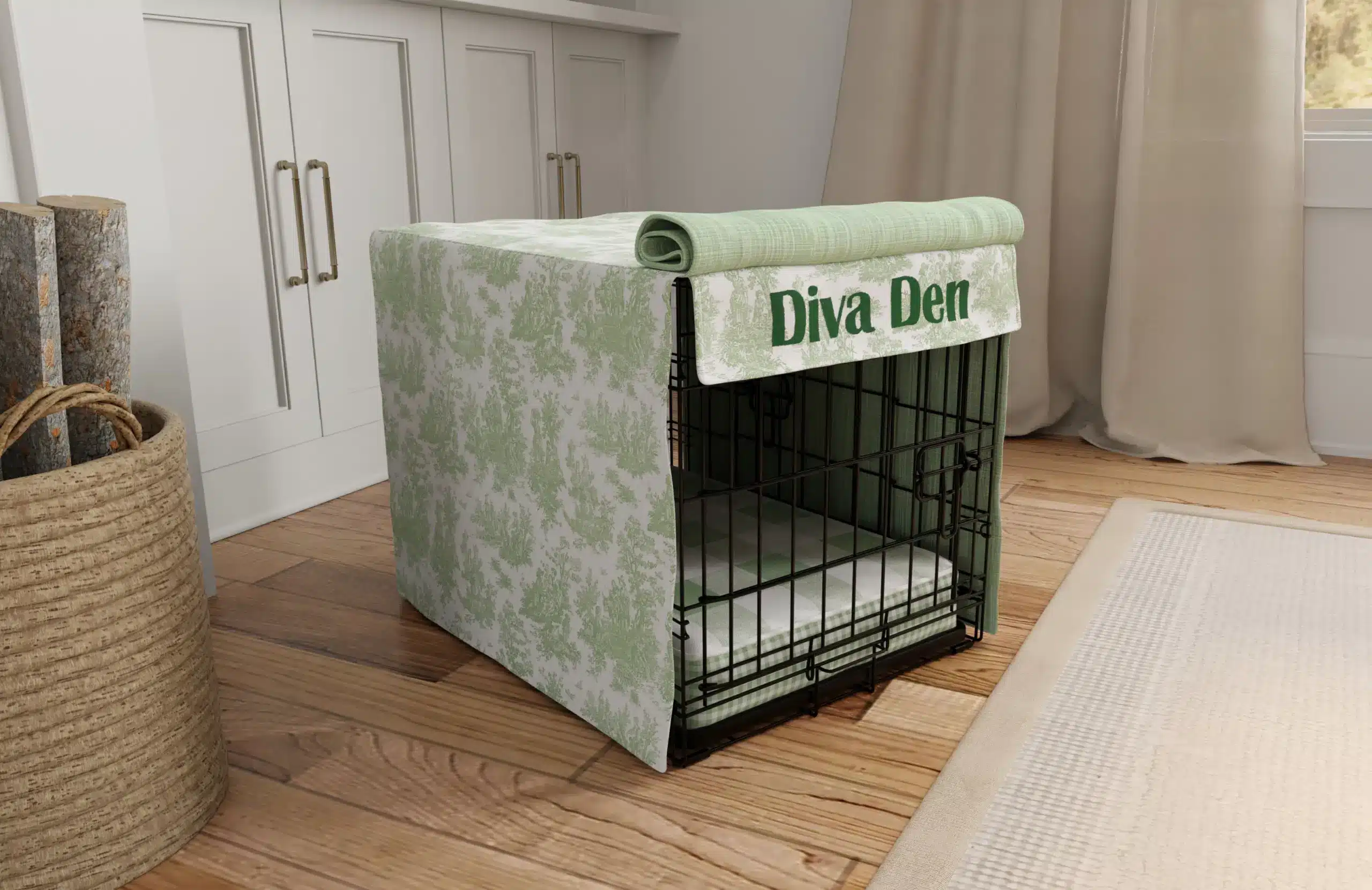
A tailored dog crate cover acts like upholstery. By choosing a fabric that complements your curtains, your sofa, or your rug, you turn the crate into a cohesive part of the room.
A stylish dog crate cover changes the narrative of the space. Instead of an eyesore, the crate becomes a side table or a quiet nook that feels intentional. Crate cover furniture look is achieved through clean lines and high-quality textiles. It signals that you care about the details of your home, and that your dog’s space is honored, not hidden.
Flexibility and Control Over Design Choices
Customization is about getting exactly what you want, not just what’s available on the shelf. It empowers you to solve specific problems.
Colors, Fabrics, and Coverage Options
With a custom dog crate cover design, you are the architect. Do you need a side panel that rolls up because that’s where the window is? You can have it. Do you want a ticking stripe to match your farmhouse decor? You can choose it.
Personalized crate cover options extend to function. You can request breathable fabrics for a hot climate or heavier canvas for a drafty room. You can choose contrasting piping to add a design detail. Crate cover fabric choices allow you to align the product with your specific taste and needs.
Why Store-Bought Options Are Limited by Scale
Mass production relies on standardization. To keep prices low, manufacturers limit their SKUs. This usually means you get a choice of tan, black, or grey. You get one door configuration.
Store bought crate cover options cannot cater to the edge cases. If you have a double-door crate, a crate with an unusual height, or a specific decor style, you are out of luck. Crate cover design limitations are the trade-off for the lower price and immediate availability.
Cost Over Time, Not Just at Checkout
The price tag is the most obvious difference, but it’s arguably the most misleading one.
Upfront Price vs Total Cost of Ownership
A custom cover costs significantly more upfront. There is no getting around that. You are paying for labor, premium materials, and individual patterning. A cheap crate cover might cost a quarter of the price.
However, crate cover value over time tells a different story. If you replace the $30 cover once a year for the 12-15 year life of your dog, you have spent $360—and you’ve lived with a subpar product the whole time. A custom cover is a one-time investment that serves you for years. The dog crate cover cost comparison should always factor in replacement frequency.
Why Replacing Covers Quietly Adds Up
There is also the hidden cost of waste. Throwing away rip-prone nylon covers contributes to landfill waste. There is the cost of your time spent shopping for replacements.
Cheap crate cover problems often involve frustration—zippers breaking at inconvenient times, or coming home to find the cover shredded. A custom crate cover investment buys you out of that cycle. It buys you reliability.
When Store-Bought Covers Make Sense
We aren’t saying custom is the only way. There are absolutely times when a store-bought cover is the smart choice.
Temporary Setups, Early Training, or Short-Term Use
If you are fostering a dog for two weeks, a temporary crate cover from a big-box store is perfect. If you are in the thick of potty training a puppy who is destroying everything in sight, a cheap puppy crate cover might be a wise sacrificial layer until they mature.
Crate cover early training is messy. It involves accidents and chewing. It might make financial sense to use a disposable option during this destructive phase and upgrade to custom once the dog has settled.
Situations Where Precision Isn’t Critical
If the crate lives in the basement, the garage, or inside a vehicle where aesthetics don’t matter, a basic crate cover is fine. If the crate is only used for ten minutes a day while you vacuum, you don’t need a masterpiece.
A simple dog crate cover works when the function is purely utilitarian and visual impact is irrelevant. Crate cover minimal use scenarios don’t always justify the investment of custom work.
When Custom Crate Covers Are the Better Choice
For most dedicated pet owners, the crate is a permanent fixture in the main living space. This is where custom shines.
Long-Term Crate Use in Shared Living Spaces
If you have to look at the crate every day, it should look good. Custom dog crate cover benefits are highest in living rooms, bedrooms, and family rooms. This is where pet friendly home design matters most.
A crate cover living room setup needs to blend in. Customization allows you to camouflage the crate or turn it into a style asset. If the crate is part of your daily life, the quality of the cover directly impacts your enjoyment of your home.
Dogs With Specific Comfort, Size, or Environmental Needs
If you have a Great Dane (hard to fit), a Bulldog (needs airflow), or a rescue with separation anxiety (needs darkness), generic covers often fail.
A custom crate cover for anxiety can be designed with heavy, light-blocking canvas and secure fasteners. A crate cover for large dogs can be sized perfectly for giant breeds that standard charts ignore. Crate cover airflow design can be tailored for health. Custom answers the specific biological and behavioral needs of the dog in a way mass products cannot.
Why Custom Wins Long-Term for Most Homes
When you weigh all the factors—aesthetics, durability, function, and cost—custom often emerges as the logical long-term winner.
Fit, Durability, and Design Working Together
The best dog crate cover is one that you don’t have to think about. It fits. It works. It looks good. Custom crate cover advantages lie in this synergy. You aren’t sacrificing style for function or durability for price. You are getting a holistic solution.
Tailored crate cover value is found in the daily satisfaction of a product that works exactly as it should. No adjusting, no re-tying, no apologizing for the mess in the corner.
Designing Once Instead of Constantly Adjusting
There is peace of mind in solving a problem permanently. An intentional crate design allows you to set up your dog’s space and move on with your life.
A long term crate solution frees up mental energy. You know your dog is comfortable. You know your home looks good. Custom crate cover longevity means one less thing on your to-do list for the next decade.
Making the Right Choice for Your Dog and Your Space
Deciding between custom and store-bought isn’t a test of how much you love your dog. It’s a practical assessment of your needs.
Questions to Ask Before You Buy Any Crate Cover
Before you decide, ask yourself:
- Where will this crate live? (Visible area vs. hidden area)
- How long will I use it? (Months vs. years)
- Does my dog have special needs? (Chewing, anxiety, heat)
- What is my budget over time? (Upfront vs. total)
This crate cover buying guide approach helps you clarify your priorities. If you value aesthetics and longevity, custom is the path. If you value speed and low upfront cost, store-bought is the path.
Why Clarity Matters More Than the “Right” Answer
There is no single “right” answer, only the answer that fits your current reality. Our goal is to provide clarity so you can make that dog crate cover decision with confidence.
Whether you choose a custom vs store bought option, understanding the trade-offs ensures you won’t be surprised by the result. You’ll know exactly what you’re buying and why.
Common Questions About Custom vs Store-Bought Crate Covers
Is a Custom Dog Crate Cover Worth the Cost?
If the crate is in a visible area of your home and you plan to use it for more than a year, most owners find the investment is worth it. The improvement in aesthetics, durability, and fit pays dividends daily.
How Long Do Store-Bought Crate Covers Usually Last?
This depends on usage, but typically a store-bought cover made of thin synthetic fabric will start to show significant wear (fading, tearing, fraying) within 6 to 12 months of daily use.
Does Custom Really Improve Fit and Safety?
Yes. Because it is made to your specific measurements, a custom cover eliminates the sagging and loose fabric that can block vents or be pulled inside the crate, reducing the risk of overheating and chewing.
When Should You Upgrade From Store-Bought to Custom?
A great time to upgrade is when your dog is fully potty trained and past the destructive puppy chewing phase, or when you move the crate from a “training area” into a main living space where decor matters.
Give Your Pet the Comfort They Deserve
Crafted by hand, built to last, and designed to match your home. Create the perfect bed for your best friend.
Customize Their Bed
0 Comment