



We tend to think of the dog crate as a “den”—a cozy, enclosed retreat where our pets can feel safe and secure. The instinct to cover a crate comes from a desire to enhance that feeling, blocking out visual stimulation and creating a calm environment for sleep. But for dogs who run hot, that instinct to cover and contain can sometimes conflict with their biological need to stay cool.
Overheating is a serious concern for many pet parents, especially those with breeds prone to heat sensitivity or those living in warmer climates. The fear is real: will covering the crate turn it into a sauna? Is it safer to leave it open, even if that means the dog is anxious and restless?
The good news is that you don’t have to choose between calm and cool. A crate cover can actually help regulate temperature if it’s designed correctly. It can provide shade and block radiant heat without trapping stagnant air. The key lies in moving away from the “throw a blanket over it” mentality and moving toward intentional design—choosing fabrics, fits, and configurations that prioritize airflow just as much as they prioritize aesthetics.
Safety isn’t about avoiding covers entirely; it’s about designing them with your specific dog’s physiology in mind. Let’s explore how to create a crate setup that offers the security of a den without the risk of overheating.
Why Some Dogs Struggle More With Heat Than Others
Not all dogs handle heat the same way. While a Rhodesian Ridgeback might happily sunbathe for hours, a Bulldog might start panting after five minutes of play. Understanding your dog’s specific risk profile is the first step in designing a safe crate environment. It’s not just about the temperature on the thermostat; it’s about how efficiently your dog can cool themselves down.
Coat Type, Size, Age, and Environment All Play a Role
The most obvious factor is coat type. Double-coated breeds like Huskies, Golden Retrievers, and German Shepherds carry their own insulation. While this coat protects them from cold, it can also trap body heat if there isn’t enough airflow to move it away from the skin.
Size matters, too. Larger dogs have more body mass generating heat, and they often take longer to cool down once their core temperature rises. Conversely, brachycephalic (flat-faced) breeds like Pugs and Frenchies struggle to pant efficiently, making them incredibly susceptible to dog heat sensitivity even in moderate temperatures.
Age is another often-overlooked factor. Puppies have yet to fully develop their thermoregulation systems, and senior dogs often have underlying health issues that make them less resilient to stress. An overheating dog crate is dangerous for any pet, but for these vulnerable groups, the margin for error is much smaller.
Why Crates Can Trap Heat Faster Than Open Rooms
A wire crate is technically open on all sides, but once you place it in a corner and add a solid plastic tray, the airflow dynamics change. The tray blocks air from coming up through the bottom. If the crate is pushed against a wall, airflow is blocked on that side.
When you add a dog to this equation, you add a heat source. As the dog exhales, they release warm, moist air. Without cross-ventilation, this heat pools inside the enclosure. Dog crate overheating happens when this heat builds up faster than it can dissipate. Unlike an open room where air circulates freely, a crate can create a microclimate that is significantly warmer than the surrounding space if ventilation concerns aren’t addressed in the design.
Recognizing the Early Signs of Overheating in a Crate
We often associate overheating with dramatic symptoms like collapse, but the early warning signs are much subtler. Recognizing these signals allows you to adjust your crate cover setup before the situation becomes dangerous.
Behavioral Cues That Often Get Missed
A dog who is too hot in their crate rarely just lies there. They become restless. You might hear them constantly repositioning, trying to find a cool spot on the tray. A restless dog crate sleeper is often a hot dog.
Panting is the most direct signal, but pay attention to the type of panting. A gentle pant after a walk is normal. Heavy, rapid panting while lying still in a crate is a red flag. If you see your dog panting in crate situations where they should be resting, it means their body is working hard to lower its temperature. Other signs dog is overheating include excessive drooling or pressing their body against the metal bars in an attempt to conduct heat away.
Why Overheating Doesn’t Always Look Dramatic at First
Heat stress is cumulative. It doesn’t always look like a medical emergency right away. A dog experiencing mild heat stress might just seem lethargic or “glossy-eyed.” They might refuse water or seem slow to respond to commands.
Overheated dog symptoms can be subtle shifts in behavior. If your dog is usually eager to go into their crate but starts hesitating or whining to get out sooner than usual, consider the temperature. Crate safety for dogs means being attuned to these quiet requests for relief. It’s better to strip back the cover and increase airflow early than to wait for obvious distress.
How Crate Covers Can Help—or Make Things Worse
A crate cover is a tool. Like any tool, its impact depends on how it is used. In the hands of a thoughtful owner, a cover can actually keep a crate cooler by blocking direct sunlight. In the hands of someone unaware of the risks, it can turn a crate into an oven.
When a Cover Supports Comfort vs When It Traps Heat
Imagine sitting under a canvas umbrella at the beach versus sitting inside a nylon tent. The umbrella provides shade and allows the breeze to pass through, keeping you cool. The tent traps solar radiation and body heat, making you stiflingly hot.
A well-designed dog crate cover functions like the umbrella. It blocks light, which can reduce anxiety and keep the dog calm (and a calm dog generates less body heat than an anxious, pacing one). However, dog crate cover overheating occurs when the cover acts like the tent—sealing the crate off from the room’s air conditioning and trapping humidity. Is it safe to cover a dog crate? Yes, provided the cover is breathable and configured to allow air to move freely.
Why Blanket Substitutes Are Especially Risky for Hot Dogs
This is the most common mistake we see. A well-meaning owner grabs a fleece blanket, a spare comforter, or a heavy sheet and throws it over the crate.
The problem with a blanket vs crate cover approach is the material. Blankets are designed to insulate. They are engineered to trap body heat to keep you warm in bed. When you drape that over a crate, you are wrapping your dog in insulation. Furthermore, blankets don’t fit; they hang heavily and block ventilation completely. Crate cover airflow issues are almost guaranteed with improvised covers. Dog crate heat problems are often solved simply by removing the heavy blanket and replacing it with a fitted, breathable textile.
Fabric Choices That Matter Most for Dogs Who Overheat
If you have a heat-sensitive dog, the fabric you choose for their cover is the single most critical decision you will make. You need a material that acts as a visual barrier without becoming a thermal barrier.
Why Breathability Comes Before Weight or Thickness
We often equate “quality” with “heaviness,” but for a hot dog, a heavy, tightly woven fabric can be detrimental. You need breathability. Breathability refers to the ability of air and moisture vapor to pass through the fibers of the fabric.
A breathable dog crate cover allows the warm air generated by the dog to escape through the weave, rather than hitting a wall and bouncing back. The best fabric for dog crate cover applications for breeds like Bulldogs or Huskies isn’t necessarily the thickest one; it’s the one with a weave that permits air exchange. Crate cover airflow starts at the microscopic level of the thread itself.
Natural Fibers vs Synthetic Materials in Warm Conditions
Natural fibers are superior for heat regulation. A cotton dog crate cover breathes. Cotton fibers are hollow and absorbent; they don’t trap heat the way plastics do.
Synthetic materials—like polyester, nylon, or microfiber—are essentially plastics. They are not naturally breathable. They tend to trap heat and humidity, creating that “greenhouse effect” inside the crate. Synthetic crate cover problems include static buildup and heat retention. For a breathable crate cover fabric, 100% cotton canvas or a cotton-linen blend is the gold standard. It provides the structure needed for a clean look while remaining permeable to air.
Design Features That Support Cooling Without Overexposure
The goal is to create a sense of enclosure without sealing the dog in. This is achieved through smart design features that give you control over how much of the crate is covered at any given time.
Panel Placement, Open Sides, and Adjustable Coverage
A static box cover is not ideal for a hot dog. You need a ventilated dog crate cover with adjustable panels. This allows you to customize the environment based on the current temperature and your dog’s needs.
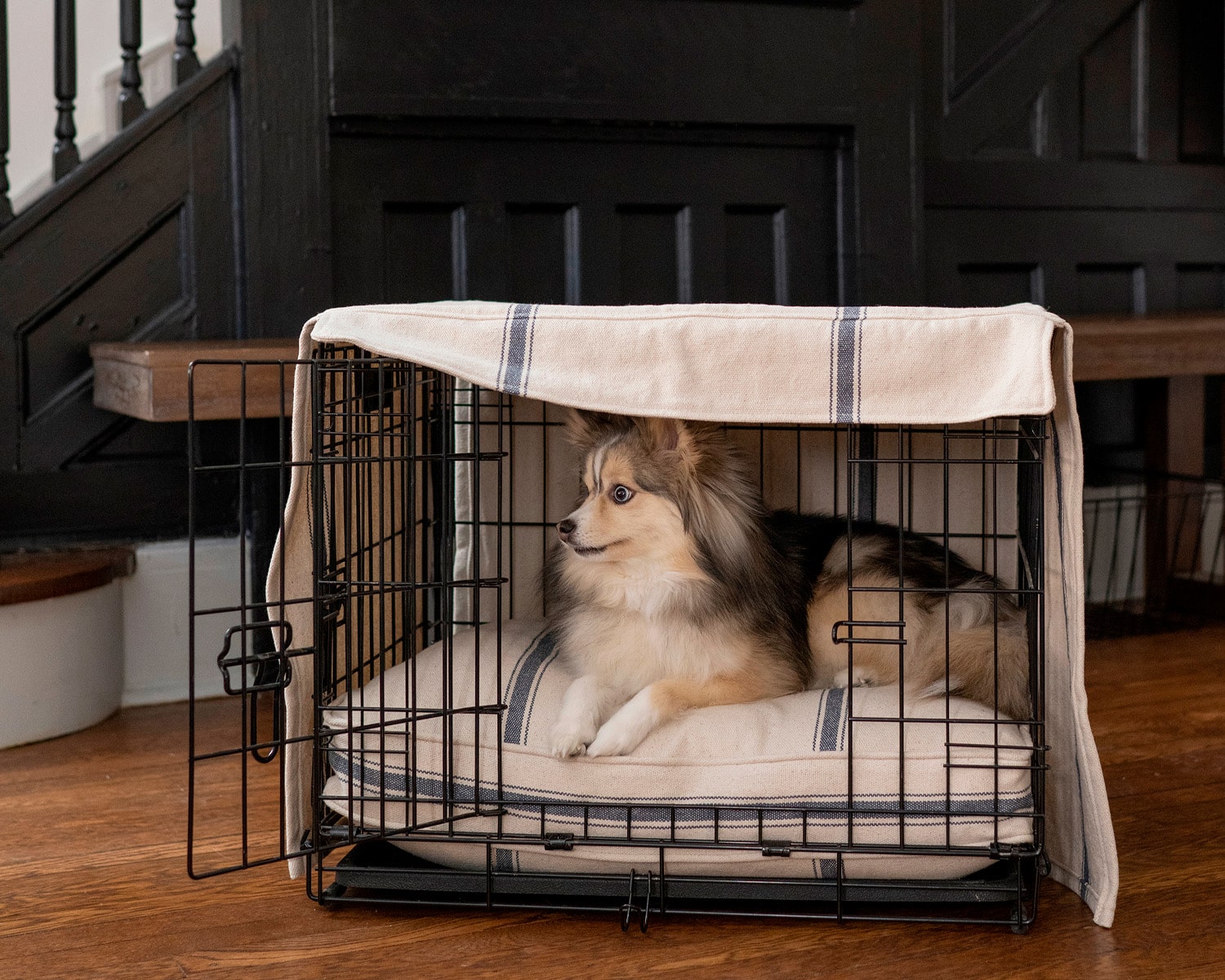
Safe dog crate cover design often involves independent panels. You should be able to roll up the sides completely while leaving the top covered to provide shade/overhead security. An adjustable crate cover lets you create a “wind tunnel” effect by opening opposite sides to encourage cross-breeze. This flexibility is crucial. On a hot day, you might have three sides open. On a cool night, you might only have the front open.
Why Total Coverage Is Rarely the Right Answer
For dogs prone to overheating, covering 100% of the wire mesh is rarely necessary or safe. Total coverage cuts off all passive airflow.
A partial crate cover strategy is often better. This might mean designing a cover that intentionally leaves the back panel open to the wall (provided there is a gap for air) or rolling up the side panels permanently. Dog crate airflow design recognizes that visual privacy can be achieved by covering just the sides the dog faces out from, without wrapping the entire unit in fabric. Crate cover safety tips always emphasize leaving at least one, if not two, sides open or mesh-exposed for heavy panters.
Airflow Isn’t Optional—It’s the Foundation
Airflow isn’t a luxury feature; it is the life support system of the crate. Without fresh air moving in to replace the warm, stale air, the temperature inside a crate will rise inevitably.
How Air Needs to Move Through a Covered Crate
Air moves in currents. It enters through low openings and exits through high ones (convection), or it moves horizontally through cross-ventilation. A dog crate airflow strategy needs to facilitate this movement.
If you cover the entire crate, you stop the horizontal movement. If the cover is too heavy, you stop the vertical movement through the fabric. Crate ventilation for dogs relies on having a clear path for air to travel. This is why we often recommend positioning the crate so that the open panels align with the room’s natural airflow or a ceiling fan. A breathable crate setup isn’t just about the cover; it’s about the physics of the room.
Why Tight Fit Without Ventilation Is a Common Mistake
A custom fit is important for aesthetics and safety, but for heat-sensitive dogs, that fit shouldn’t be airtight. A common dog crate cover mistake is fitting the cover so tightly that it seals against the plastic tray at the bottom.
There should be a slight gap at the hem—just an inch or so—to allow cool air from the floor to be drawn up into the crate. An overheated crate cover is often one that goes all the way to the ground, blocking that lower intake of air. Crate cover fit issues aren’t just about looking sloppy; a cover that is too perfectly sealed can be dangerous.
Placement and Room Conditions Matter More Than People Expect
Even the most breathable cover cannot cool a crate if the crate is placed in a heat trap. The environment surrounding the crate dictates the baseline temperature.
Sun Exposure, Vents, and Floor Temperature
Never place a crate in direct sunlight, regardless of whether it is covered. A crate near window dog setup is risky because the sun heats the metal bars and the bedding, turning the crate into a radiator. The cover might block the light, but the heat still penetrates.
Conversely, think about HVAC vents. Don’t place a covered crate directly over a heat register in winter, or block a return vent. Dog crate placement should prioritize a neutral, draft-free spot. Also, consider the floor. A tile or wood floor stays cooler than a thick carpet. Dog crate temperature control starts with where you put the box.
Why a “Cool Room” Doesn’t Guarantee a Cool Crate
Just because your living room feels comfortable to you doesn’t mean the inside of the crate is comfortable for your dog. You are standing up, moving around, and wearing light clothes. Your dog is in a confined space, wearing a fur coat, and generating heat.
Dog crate heat buildup can happen even in an air-conditioned room if the air isn’t circulating into the crate. Overheating in dog crate scenarios often happens because owners assume the ambient room temperature applies to the micro-environment of the crate. It usually doesn’t—the crate is almost always warmer. Crate airflow issues mean you have to be proactive about ensuring that cool room air actually gets to your dog.
Why Custom Design Matters Most for Heat-Sensitive Dogs
This is where the difference between a generic “bag” cover and a custom-designed piece becomes a safety feature. Customization allows you to build a cover specifically for your dog’s thermal needs.
Controlling Fabric, Fit, and Coverage Together
With a custom dog crate cover, you aren’t stuck with whatever cheap polyester the manufacturer used. You can specify a breathable, 100% cotton canvas. You can request specific panel configurations—like a permanent open back or extra tie-ups on the sides.
A made to order crate cover gives you control over the fit. You can ensure the hemline allows for bottom airflow. You can ensure the panels roll up high enough to clear the mesh completely. A breathable custom crate cover is engineered, not just sewn. It integrates your knowledge of your dog’s health with the design of the product.
Designing for Flexibility as Temperatures Change
Seasons change. Your crate cover should adapt. An adjustable dog crate cover designed with custom tie-backs allows you to change the configuration from winter (cozier, more enclosed) to summer (maximum airflow).
Custom crate cover benefits include this adaptability. You aren’t buying a separate cover for every season; you are buying one versatile system. Crate cover seasonal use becomes seamless when the design allows you to peel back layers without removing the cover entirely.
Common Design Mistakes That Increase Overheating Risk
Even with good intentions, it’s easy to make design choices that inadvertently increase heat risk. Awareness of these pitfalls is key to prevention.
Over-Insulating, Over-Covering, and Over-Trusting Fabric Labels
Beware of marketing terms like “insulating” or “blackout” if you have a hot dog. While these features sound great for sleeping, they often mean the fabric has a coating that blocks air.
Dog crate cover safety relies on skepticism. Don’t assume a fabric is breathable just because it looks light. Crate cover overheating risks rise when we layer aesthetic choices—like putting a cute quilt over the crate—without considering the thermal impact. Dog crate cover problems often stem from treating the crate like a decorative object rather than a functional habitat.
Why “Heavy Duty” Isn’t Always Safer for Hot Dogs
We often associate “heavy duty” with quality. But a heavy crate cover made of coated nylon or thick vinyl is essentially a tarp. It is waterproof and tough, but it breathes like a plastic bag.
For a dog who runs hot, “heavy duty” can be a hazard. The best crate cover for warm dogs is actually “medium duty”—strong enough to hold shape, but porous enough to breathe. Crate cover fabric weight should be balanced against the need for ventilation. A 10oz canvas is usually the sweet spot—tough but breathable.
Balancing Security and Cooling for Dogs Who Run Hot
The ultimate goal is to find the equilibrium. You want your dog to feel secure and hidden, but you also need them to be safe and cool.
Creating Shade Without Creating Stagnant Air
Think of the cover as a shade structure. Its primary job for a hot dog is to block visual stimuli and create a darkened space, which signals sleep time. A cooling dog crate setup uses the cover to create this shade while leaving the “windows” open.
Dog crate shade is powerful. It lowers the ambient temperature inside the crate compared to direct exposure. Safe crate cover for summer strategies involve using the top panel to create that roof, while keeping the sides rolled up or using a very loose weave fabric on the sides to prevent stagnant air pockets.
Why Calm Comes From Comfort, Not Containment
A dog cannot be calm if they are physically uncomfortable. If they are too hot, they will be anxious, panting, and pacing. No amount of “den-like security” will overcome the physiological stress of overheating.
A calming dog crate cover is, first and foremost, a comfortable one. Dog crate comfort is holistic. It includes the softness of the bed, the security of the walls, and the quality of the air. When you prioritize a breathable crate environment for dogs, you are removing a major source of physical stress, which allows the dog to actually settle down and rest.
Planning for Long-Term Comfort, Not Just Summer
Overheating isn’t just a summer issue. Dogs can overheat in winter if the heating is cranked up or if they are near a fireplace. Your design choices need to work year-round.
How Custom Covers Adapt Across Seasons
A year round dog crate cover needs to be a transformer. In the winter, you might roll the panels down to block drafts. In the summer, you roll them up to catch the breeze.
A seasonal crate cover doesn’t have to be replaced; it just has to be adjustable. Custom crate cover longevity comes from this utility. You are designing a system that works on the hottest day of July and the coldest night of January simply by changing how you secure the panels.
Designing Once Instead of Constantly Adjusting
When you invest in a custom dog crate cover value proposition, you are investing in a “set it and forget it” solution. You don’t need to pile blankets on in winter and strip them off in summer. You don’t need to buy fans and cooling mats constantly.
By designing an intentional crate design with breathability and adaptability at its core, you create a stable, safe environment for your pet. A long lasting crate cover is one that supports their health every single day, regardless of the weather outside.
Common Questions About Crate Covers and Overheating
Can a Dog Overheat in a Covered Crate?
Yes, absolutely. If the crate is covered with a non-breathable material (like a heavy blanket or synthetic fabric) and lacks proper airflow, the temperature and humidity inside can rise to dangerous levels, leading to heat stress or heat stroke. This risk is higher for brachycephalic breeds, large dogs, and double-coated breeds.
What Fabrics Are Best for Dogs Who Run Hot?
100% natural fibers are the best choice. Cotton canvas and duck cloth are ideal because they are naturally breathable and allow moisture and heat to escape. Avoid polyester, nylon, and heavy fleece, as these materials trap heat.
How Much of a Crate Should Be Covered for Airflow?
For a dog prone to overheating, you should rarely cover the entire crate. Leaving at least one side (usually the side facing the wall or a quiet part of the room) completely open allows for cross-ventilation. An adjustable design that lets you roll up all side panels while keeping the top covered for shade is often the safest configuration.
Why Is Custom Design Safer for Heat-Sensitive Dogs?
Custom design allows you to choose breathable materials and specify panel configurations that prioritize airflow. Unlike generic covers that might fit too tightly or use cheap, heat-trapping synthetics, a custom cover can be tailored to provide shade without sacrificing ventilation, offering a safer environment for your specific dog.
Give Your Pet the Comfort They Deserve
Crafted by hand, built to last, and designed to match your home. Create the perfect bed for your best friend.
Customize Their Bed
0 Comment