



For pet owners with a dog that is sensitive to the world, creating a sense of calm is a daily priority. You might notice your dog is quick to react to sounds from the street, gets overly excited when guests arrive, or seems unable to settle down even when they are tired. When it comes to crate time, which is meant to be a period of rest, these sensitivities can be amplified. A standard wire crate, placed in the middle of a home, offers little protection from the constant stream of sensory information that can keep a nervous dog on high alert.
The goal is to provide a safe space where a dog can truly rest, not just be contained. This is where the design of a crate cover becomes a thoughtful tool for managing the environment. For a reactive or nervous dog, a crate cover isn’t just a decorative item; it’s a way to buffer them from the triggers that make it hard to relax.
Choosing the right design involves more than just blocking out the world. It’s a careful balance of providing security without causing isolation, and controlling stimulation without creating new sources of stress like heat or confinement. By approaching the crate setup with an understanding of environmental management, you can create a space that genuinely supports a calmer state of mind.
Understanding the Environmental Triggers That Make Crates Harder to Tolerate
A dog that is labeled “reactive” or “nervous” is often simply a dog with a heightened sensitivity to their environment. In an uncovered wire crate, they are fully exposed to a world that is filled with triggers. For a dog whose nervous system is already primed to be on alert, this exposure can make settling down feel impossible. It’s like asking a person to meditate in the middle of a loud, crowded room—it’s just too much to ignore.
A reactive dog crate setup requires thinking about what the dog is experiencing. It’s not about a character flaw in the dog; it’s about an environment that is overwhelming. From their perspective, the home is a constant source of unpredictable events. A shadow moving across the floor, a car door slamming outside, or a child running through the living room can all be perceived as something that requires their attention. When they are in a crate, they cannot act on these impulses by running to the window or greeting the person, which can lead to frustration, barking, or pacing. The crate becomes a place of contained agitation rather than calm.
Movement, Sound, and Visual Stimulation in Busy Homes
An overstimulated dog in a crate is a dog whose brain is working overtime. They are constantly processing data from their surroundings, which prevents them from entering a state of deep rest.
Visual Stimulation: This is one of the most powerful triggers. For a dog with a strong prey drive, a squirrel running across the lawn is a major event. For a territorial dog, the mail carrier walking up the path is a perceived threat. Even inside the home, the simple act of a family member walking into the kitchen can be enough to pull a dog out of a light sleep. An uncovered crate offers a front-row seat to all this action, making it very difficult for the dog to disengage.
Sound: Dogs have a far more acute sense of hearing than humans. They can hear high-frequency sounds we can’t detect and can pinpoint the source of a sound from four times the distance. The doorbell, the dishwasher running, or neighbors talking outside can all be sources of stimulation. A wire crate does nothing to muffle these sounds, leaving the dog to process the full auditory landscape of the home.
Constant Activity: In a busy family home, there is always something happening. People are moving, talking, and cooking. Other pets may be playing. A nervous dog crate setup must account for this. Without a clear boundary, the dog in the crate remains mentally tethered to all this activity, unable to understand that it’s time for them to be still.
Designing for Light Control Without Making the Crate Feel Closed Off
For a reactive or nervous dog, managing visual input is often the most impactful change you can make. A dog crate light blocking cover helps to draw a curtain on the world, signaling that it’s time to rest and that they are no longer on duty. However, there’s a fine line between creating a calming, dark den and creating a space that feels claustrophobic or isolating.
The goal is not to create a sensory deprivation chamber. Complete isolation can be frightening for some dogs, especially those who find comfort in knowing their owner is nearby. A well-designed crate cover for reactive dogs allows you to modulate the environment. It provides visual boundaries where they are most needed while still allowing for a connection to the rest of the home. This balance is key to building a dog’s confidence and comfort in their crate.
Balancing Visual Boundaries With Openness and Safety
The most effective dog crate cover for anxiety is one that is both flexible and safe. It should allow you to control what the dog sees without compromising their physical well-being.
Strategic Coverage: You don’t necessarily need to cover the entire crate. Often, the most effective approach is to cover the sides and back of the crate, leaving the front door panel open. This blocks peripheral vision, which is often responsible for catching the quick movements that trigger a reaction. It creates a “three-walled” den that feels protected, but the dog can still see out the front to orient themselves and see that their family is near.
Adjustable Panels: Designs that feature roll-up panels offer the ultimate flexibility. You can customize the level of coverage based on the situation. If the house is particularly busy, you can lower all the panels to create a quiet, dark retreat. On a calm day, you might roll up the front and one side to allow for more light and air. This adjustability allows you to respond to your dog’s needs in real-time.
Safety First: Any amount of coverage must be done safely. The fabric must be breathable to prevent overheating, and the fit must be secure so it cannot be pulled into the crate. The ability to control light should never come at the expense of proper airflow.
Using Fabric Choice to Soften Sound, Not Silence It
While no fabric crate cover can soundproof a crate, the right material can make a noticeable difference in dampening ambient noise. For a dog sensitive to sound, this slight muffling effect can be incredibly beneficial. It takes the sharp edges off startling noises like a dropped pan in the kitchen or a car horn outside, reducing the jolt to their nervous system.
A thin, flimsy fabric will do little to absorb sound waves. In fact, a rustling polyester cover can create more noise and stress. The key is to choose a material with enough weight and density to act as a gentle acoustic buffer. Think of it like the difference between thin cotton curtains and heavy velvet drapes; the heavier fabric absorbs more sound, making the room feel quieter and more serene.
How Weight, Weave, and Texture Affect Noise Sensitivity
When selecting the best fabric for a dog crate cover, consider its acoustic properties.
Weight and Density: A heavyweight cotton canvas or a dense, upholstery-grade linen blend is an excellent choice. The thickness of these materials helps to absorb and dampen sound frequencies. A noise reducing dog crate cover made from a substantial fabric helps to create a more muted environment inside the crate.
Weave: A tight weave with a textured surface is more effective at scattering and absorbing sound than a smooth, flat surface. The irregular texture helps to break up sound waves rather than letting them bounce around.
Softness: Beyond acoustics, a soft-feeling fabric contributes to the overall sense of calm. A calming dog crate cover made from a fabric that doesn’t rustle or make sharp noises when touched or moved creates a quieter space. This is where natural fibers excel over synthetic ones, as they tend to be quieter.
By choosing a fabric with the right physical properties, you are not just covering the crate; you are adding a layer of environmental insulation that can help a sensitive dog feel more secure.
Why Adjustable, Fitted Designs Matter for Reactive Dogs
For a dog that is sensitive to their environment, consistency and predictability are paramount. An environment that is stable and unchanging is an environment that feels safe. This is why the fit and function of a crate cover are so important for a reactive dog. A cover that is tailored to the crate and functions predictably becomes a reliable part of their daily routine.
An adjustable dog crate cover with a precise fit provides that sense of stability. The dog learns that when the panels are down, the world gets quiet. They learn that the cover won’t slip, sag, or move unexpectedly. This predictability helps them to relax because they know what to expect. In contrast, an inconsistent environment—like a blanket that is sometimes on, sometimes off, sometimes half-fallen—creates uncertainty, which can heighten a nervous dog’s anxiety.
Consistency, Stability, and Predictable Coverage
A fitted dog crate cover provides several key benefits for a dog that thrives on routine.
Stability: A cover that is made to the exact dimensions of the crate fits snugly and securely. It doesn’t shift or slide if the dog bumps against the side of the crate. This stability creates a sense of a solid, permanent structure, much like the walls of a room. For a dog that is easily startled, this feeling of solidity is very grounding.
Predictable Function: An adjustable dog crate cover with well-designed roll-up panels that can be secured with ties or toggles operates the same way every time. The dog learns the routine: the sound of the ties being undone signals that it’s time to come out. This predictability reduces anxiety around transitions in and out of the crate.
Consistent Environment: A fitted cover ensures that the internal environment of the crate remains consistent. The airflow is always reliable, the level of darkness is controllable, and the space feels the same every time they enter it. This consistency is the foundation upon which a dog can build a positive association with their crate as a place of rest.
Where One-Size-Fits-All Covers Often Create More Stress
Many pet owners, in an effort to help their dog, will start with a one-size-fits-all crate cover. Unfortunately, these mass-produced products are often designed with cost and convenience in mind, not the specific needs of a sensitive dog. The very design flaws in these generic covers can inadvertently create new sources of stress.
A one-size-fits-all crate cover, by its nature, is a compromise. It is designed to loosely fit a range of crate sizes, which means it rarely fits any single crate well. This poor fit is not just an aesthetic issue; it can lead to functional problems that make a dog feel less secure, not more. The fabric is often chosen for its low cost, not its breathability or sound-dampening qualities. For a reactive dog, these details matter immensely.
Poor Fit, Shifting Fabric, and Uncontrolled Exposure
The problems with generic covers often make them unsuitable for dogs with environmental sensitivities.
Poor Fit and Sagging: Crate cover fit issues are the most common problem. A baggy cover can sag into the crate, reducing the dog’s usable space and potentially making them feel confined. A dog might be startled if they stand up and brush against fabric that wasn’t there a moment ago.
Shifting Fabric: A cover that is not secured can easily be pulled into the crate by a bored or anxious dog, creating a messy and potentially unsafe tangle of fabric. It can also slip off one side, suddenly exposing the dog to the very visual triggers you were trying to block. This unpredictability is the enemy of a calm environment.
Uncontrolled Exposure: Many generic covers are simple drapes with no way to adjust the panels. This leaves the owner with an all-or-nothing choice that doesn’t allow for the nuanced control a reactive dog needs. These common dog crate cover problems mean you can’t fine-tune the environment to match your dog’s comfort level.
How Custom Design Supports a More Controlled Crate Environment
Choosing a custom dog crate cover is about taking control of the variables. It allows you to move away from a flawed, one-size-fits-all solution and create a tool that is intentionally designed to support your dog’s specific needs. It acknowledges that for a sensitive dog, the details of their environment are not trivial—they are central to their well-being.
A made-to-order crate cover is crafted to your crate’s exact measurements, from a fabric you select, with features you specify. This level of personalization allows you to build the ideal calming den from the ground up, addressing the potential pitfalls of generic designs. It’s an investment in creating a stable, predictable, and supportive space that can help your dog feel more secure in their home.
Intentional Coverage That Can Be Adjusted Over Time
The benefits of a personalized dog crate cover are most apparent when dealing with a dog that needs a carefully managed environment.
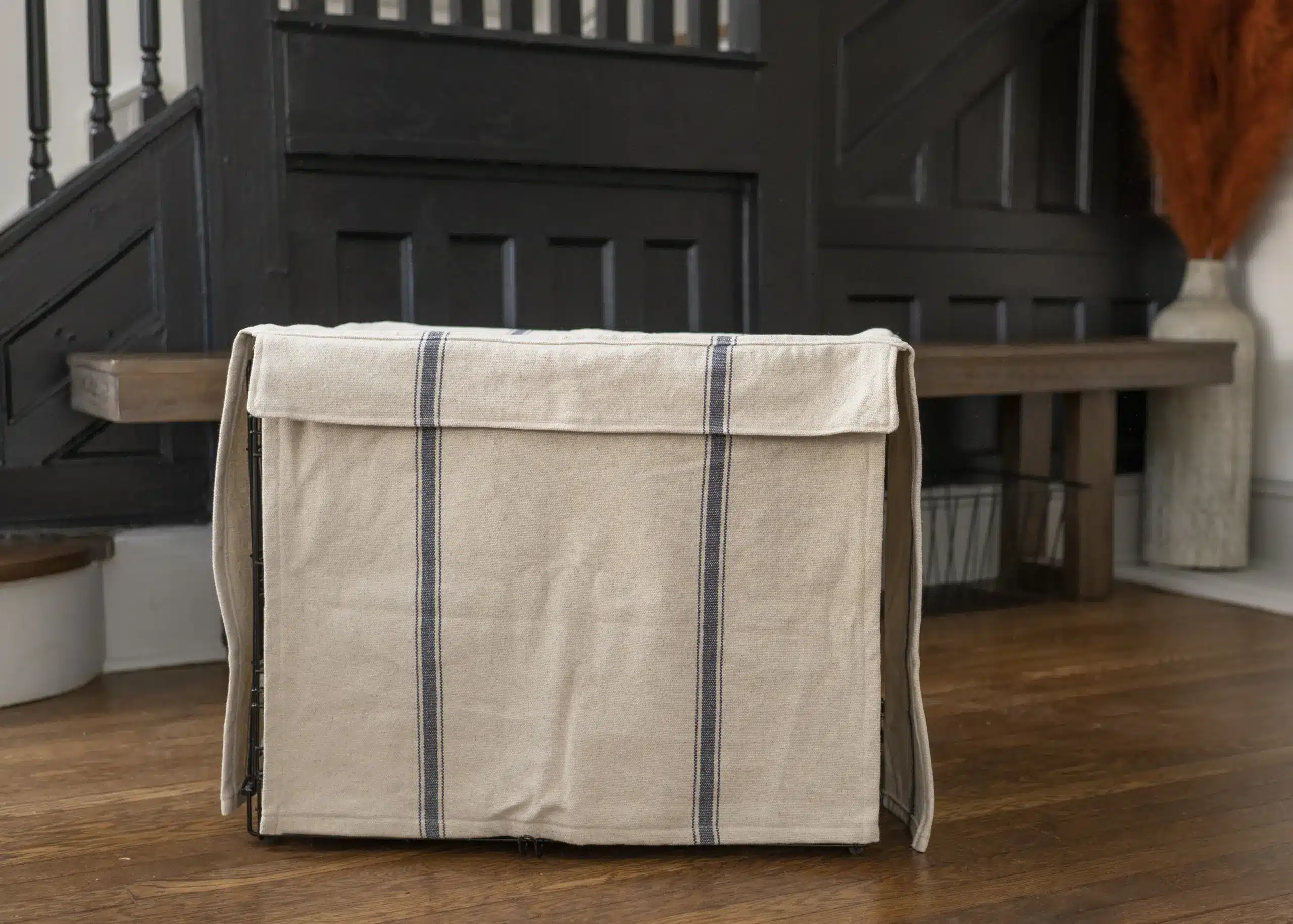
Intentional Fit: A custom fit eliminates the stress of a shifting, sagging cover. It creates a clean, architectural look that feels stable and secure, both to you and your dog.
Deliberate Fabric Choice: You can choose a heavy, breathable, natural fabric like canvas for its sound-dampening and safety qualities. You can select a dark, solid color to maximize the den-like feeling. You are in control of the material’s properties.
Adjustable and Future-Proof: With a custom design, you can incorporate features like independently operating roll-up panels. This allows you to provide the perfect amount of coverage for your dog right now. As your dog grows more confident, you can gradually increase the amount of exposure, using the same cover to support them through different stages of their training and development. This is one of the most powerful custom crate cover benefits—it adapts with you.
Common Questions About Crate Covers for Reactive Dogs
What Kind of Crate Cover Is Best for a Nervous Dog?
The best crate cover for a nervous dog is one that is made from a heavy, breathable fabric (like cotton canvas), fits the crate snugly without sagging, and features adjustable panels. This combination provides a sense of security by dampening sound and blocking visual triggers, while ensuring the dog stays cool and comfortable. The ability to roll up panels allows you to customize the level of coverage to what your dog finds most reassuring.
Can a Crate Cover Reduce Overstimulation?
Yes, a crate cover can be a very effective tool for reducing overstimulation. By creating a visual barrier between the dog and the activity in the home, it lowers the amount of sensory input the dog has to process. This helps to prevent the “trigger stacking” that can lead to a reactive state, allowing the dog’s nervous system to switch from high alert to a mode of rest.
How Much Coverage Is Too Much for a Reactive Dog?
Coverage becomes “too much” if it causes the dog to overheat or feel trapped. Never use a non-breathable material, and always ensure there is good airflow. For some dogs, covering the crate completely can cause anxiety if they are not used to it. It is often best to start by leaving the front panel open and gradually introducing more coverage as the dog becomes more comfortable. A dog who is panting heavily, whining, or trying desperately to get out may be telling you the setup is too enclosed for them.
Give Your Pet the Comfort They Deserve
Crafted by hand, built to last, and designed to match your home. Create the perfect bed for your best friend.
Customize Their Bed
0 Comment