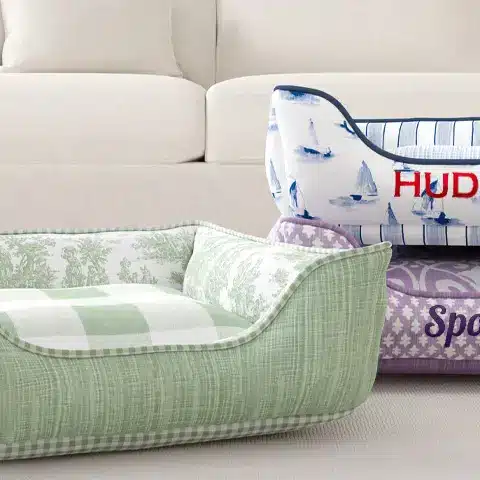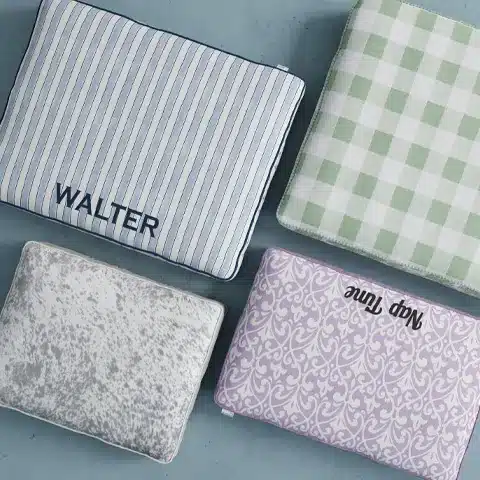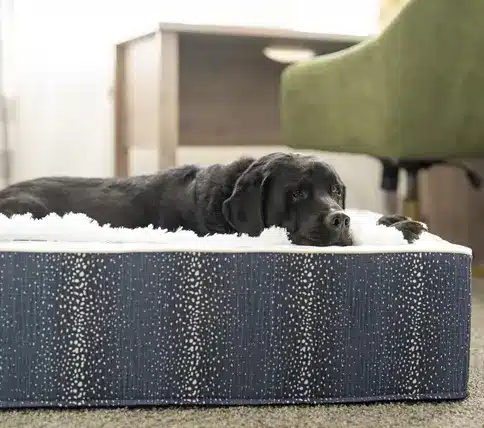

The short answer: no fabric is chew-proof, and any bed that says otherwise is making a promise it cannot keep. What actually survives a chewer is a bed built from parts you can replace one at a time, sewn from upholstery-grade fabric with zippers that do not tempt a puppy, filled with something that holds its shape, and set up so your dog has less reason to chew in the first place.
We have made beds to order since 2012, and chewed beds are one of the most common reasons people come to us. Not because our fabric is tougher than teeth, but because a J’adore bed is designed so that a chewed cover or a torn insert is a replacement part, not a trip to buy a whole new bed. Here are the seven things that matter, in the order we would check them.
1. A cover you can replace without replacing the bed
The outer cover takes nearly every bite. On most store-bought beds the cover is sewn shut around the fill, so one chewed corner means the whole bed goes in the trash. On every J’adore bed the cover unzips and comes off, and you can order a new one in any fabric from our current collection.
That is the single biggest reason a bed outlasts a chewer. A replacement cover is made to the exact style and size you ordered, including custom sizes, and costs a fraction of a new bed. As an example, a replacement cover for a Medium Rectangle bed is $109.99, against $149.99 and up for the bed itself. You can also choose a different fabric for the new cover, so a puppy’s chewing phase becomes an excuse for a new look rather than a loss.
If you expect some damage, order a second cover with the bed. One is on the bed while the other is in the wash or waiting in the closet, and a chewed cover never leaves your dog without a place to sleep.
2. An insert you can replace too
A determined chewer gets through the cover and into the fill. When that happens with a one-piece bed, you are done. When it happens with a J’adore bed, you order a new insert.
Our replacement inserts are made in the same size and fill as the bed you own. A Medium Rectangle Premium Fiberfill insert is $105, and the price updates as you choose the size and the fill. The cover you already have zips back on, and the bed is whole again.
Being able to replace either half of the bed independently is what we mean when we say the bed survives. The bed your dog knows stays in the same spot, with the same smell and the same shape, and only the damaged part changes.
3. Upholstery-grade fabric that has already been washed
Fabric weight matters less than people think against a dog’s teeth, but it matters a great deal against everything else a chewer does: digging, scratching, dragging the bed around and the extra washing that follows. Every J’adore bed is cut from upholstery-grade fabric, the same weight used on furniture, and every fabric is pre-washed before it is cut and sewn so the cover keeps its fit wash after wash.
Within our 300+ fabrics, a few families are worth a look for a dog who is hard on a bed:
- Bull Denim (Gray, Sahara): a heavy cotton twill with a dense, tight weave.
- Faux leather (Western Chestnut Faux Leather, Western Chestnut, Rustic Mesa, Rustic Stone): a smooth surface that hair and dirt sit on top of rather than working into.
- Slub Canvas and Luxe Canvas: our largest family of woven fabrics, with the widest range of solids and patterns, so a replacement cover can match the room.
Fabric samples are $1.99 each, so you can feel the weight before you decide. Our fabric guide compares each family in more detail.
4. Zippers a puppy cannot get a tooth under
Ask anyone whose dog destroyed a bed where it started and the answer is usually the zipper or a loose seam. A pull tab that sticks out is a toy. A zipper that gaps is a handle.
Our covers use concealed, industrial-grade zippers sewn into the seam so there is nothing to grab. Cushion beds have one long wrap-around zipper along the side band, and bolster beds have five separate zippers, one for each insert, so you can take the bed apart to wash it without any exposed hardware on the surface your dog lies on. Keeping the zipper closed before every wash, which is also the right way to care for the cover, keeps the teeth from snagging the fabric.
5. A fill that keeps its shape
A bed that goes flat invites digging. Dogs scratch and nose at a lumpy bed to make a comfortable spot, and once the cover is loose over a sagging insert it is easy to catch in the teeth. A fill that stays supportive gives a chewer less to work on.
| Fill | How it holds up | Which beds offer it |
|---|---|---|
| Premium Fiberfill | A down-alternative clusterfill, stuffed on the firm side, with sewn channels that keep the fill spread evenly. If your dog likes it softer, unzip the insert and take some out. | Every bed |
| 4″ Memory Foam | Four-pound density foam that spreads weight evenly and holds its shape. Typical life 10+ years. | Rectangle, Square, Round, Cave, and the seat of the Cuddle, Cozy Cuddle, Edgy and Throne |
| High-Density Foam | Our firmest fill, 4″ or 5″ thick, with batting top and bottom. Typical life 12+ years. | Rectangle and Square; always in the Throne’s sides |
For a dog who digs before settling, Premium Fiberfill is forgiving and can be fluffed back. For a heavy dog whose weight flattens an ordinary bed, high-density foam stays put. Our fill guide walks through each one.
6. A crate setup for the puppy months
Most chewing is a phase, and most of it happens when a young dog is left alone with nothing to do. A crate turns that unsupervised time into a nap. The two pieces that make a crate a place a puppy wants to be are a cushion cut to the crate floor and a cover that makes it a den.
A crate cushion is a Rectangle bed made as a custom size to the inside of your crate, so it lies flat wall to wall with no loose edge to lift and chew. A crate cover, from $124.99 and made to your crate’s front, sides and height, blocks the visual traffic that keeps a puppy keyed up. Order the two together and the crate cover is 15% off when bundled with a bed.
Our crate cover tips for puppies who chew covers how to fit a cover so there is no loose fabric hanging inside the bars.
7. Less reason to chew: size, placement and something better to bite
The last item is not about the bed at all. A dog who is bored, under-exercised or anxious will chew whatever is closest, and the bed is closest. Three habits help:
- Size the bed correctly. A bed that is too small gets dragged and bunched, which puts seams in reach. Measure your dog nose to the base of the tail stretched out, add 8 to 12 inches for a cushion bed or 5 to 8 inches for a bolster bed, and check the weight guide. Our size guide has the charts.
- Put it where they can settle. A bed in a quiet corner, out of the doorway traffic, gets slept on instead of played with.
- Give them a chew that is meant to be chewed. A durable chew toy next to the bed gives a teething puppy or a bored adult an outlet that is not the piping.
If chewing started suddenly in an adult dog, or comes with pacing, drooling or damage around doors and windows, talk to your vet or a trainer. That is usually anxiety rather than a bed problem, and the bed is only the symptom.
What our warranty does and does not cover
It is worth being clear here. Every J’adore product carries a 1-year limited warranty on craftsmanship: a seam that opens or a zipper that fails, we repair or replace. Damage from chewing, digging or staining is not a defect in craftsmanship and is not covered, by us or by anyone making an honest promise. What we offer instead is a bed where the damaged part is the only part you pay to replace. Our guarantee page has the full terms.
Every bed is handmade to order in our Kansas City workroom, ships free by ground within the continental US, and has earned a 5.0 rating from 950+ reviews. If you are starting from scratch, design your own bed and pick a fabric you would be happy to see again on the replacement cover.